© Rahul Varma, March 4, 2026
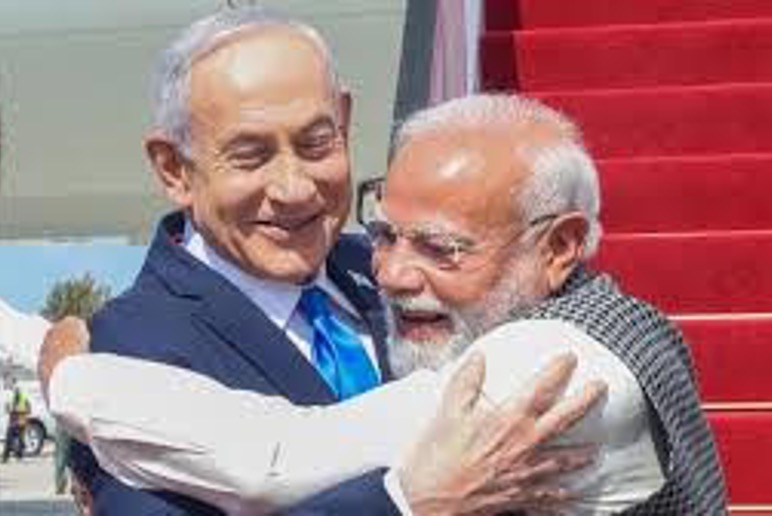
Indian Prime Minister Narendra Modi visited Israel for two days, from February 25 to 26, 2026. During this visit, he signed a historic trade and security agreement with Israel. Two days after Modi’s return to India, the U.S. and Israel carried out a devastating airstrike on Iran, killing Iran’s supreme leader, his family, and many civilians. In retaliation, Iran attacked Israel and U.S. military bases in the Gulf countries. Shortly thereafter, Modi and Canadian Prime Minister Mark Carney announced a multibillion-dollar partnership and committed to signing a major free trade agreement by the end of the year. By the 9th day of the war against Iran, 1,255 civilians had been killed, with the number continuing to rise. In a heartbreaking attack, US warplanes targeted a primary girls’ school in Minab, resulting in the deaths of 165 schoolgirls and injuring many more.
These events raise the question: are they merely coincidental, or do they signify something bigger?
Modi’s visit to Israel—the first by an Indian Prime Minister—represents a broader geopolitical transformation. His exuberant meeting with Israeli Prime Minister Benjamin Netanyahu, a fugitive indicted for war crimes by the International Criminal Court, is a significant departure from India’s long-standing support for Palestinian self-determination.
Modi’s visit to Israel, especially when most countries are avoiding it, portrays him as an egregious leader subservient to a state that most around the world recognize as committing crimes against humanity. His address in the Knesset was inaccurate, distorted, contained bizarre claims, and displayed his anti-Muslim hatred. While he condemned the Hamas attacks, denounced terrorism, mourned Israeli civilian casualties, he remained dead-silent about the deaths of over 82,000 Palestinian civilians, including 18,000 children, the reduction of Gaza to rubble, human suffering and starvation. While international law mandates the protection of civilians universally, Modi overlooked the deaths and suffering of Palestinian civilians, and in doing so, he created a hierarchy of grief: Israeli civilians are valued, and the Palestinian civilians are disposable.
Modi embarrassed India by establishing a genealogical connection between India and Israel, accused of genocide, when he stated, “Israel is the Fatherland, India is the Motherland.” His mystical neurosis didn’t end with “Fatherland and Motherland”; he made an even more absurd connection by saying, “The day India recognized Israel is the day I was born.” With this mythological madness, Modi professed that he was preordained to arrive on earth the same day India would recognize a settler colonial state committing ethnic cleansing. Modi views himself as a figure destined to unite the Motherland (India) and the Fatherland (Israel) against the enemy (Palestine). Mr. Modi transformed India’s foreign policy into a doctrine of divinity.
Modi’s laughable statements abroad emerge from the exaggerated sense of divinity he projects at home. In 2024, during an interview, he claimed that after his mother’s passing, he realized that he was not born biologically but was instead sent by “परमात्मा“ (Supreme Soul) to perform God’s divine work. Using such a messianic spell, Modi has fostered a cult of personality within his Hindu nationalist Bharatiya Janata Party (BJP). The unique selling point of the BJP is the strong connection it promotes between the Hindu religion and politics, and thus promoting a distorted Hinduism in every aspect and in the everyday lives of the people. Modi’s belief that God chose him to fulfill a divine purpose parallels the belief in Israel that the Jews are a chosen people.
Modi’s God complex is evident in his Hindutva politics, which originated from the BJP’s parent organization, the RSS. Notably, the RSS did not participate in India’s struggle for independence from British colonialism. Despite this, Modi has successfully mobilized Hindu support for his party by inciting slogans like अंग्रेजों के गुलाम (slave of white people). In reality, by bending over backward to shake hands with Netanyahu, Modi is demonstrating his slave mentality to white powers.
Modi’s visit to Israel marks a significant shift in India’s post-independence policy, which was based on anti-colonial solidarity and non-alignment, jointly developed by Prime Minister Nehru and leaders from Egypt and Yugoslavia. The non-aligned movement followed the principle of non-aggression, non-interference, mutual growth, and advocated against power-politics to prevent global conflicts. Thus, India strongly opposed settler colonialism in Palestine and was one of the first non-Arab nations to recognize the State of Palestine (1988). India viewed the struggle in Palestine as akin to her own battle against British rule, and continually advocated for Palestine’s freedom from settler colonialism. In contrast, since taking power in 2014, Modi systematically reversed India’s principled legacy. He disregards Palestinian sovereignty and focuses instead on security, surveillance, drones, cybersecurity, and support Israeli ethno-nationalism.
Under Modi, Israel has become India’s leading defence supplier, accounting for approximately 34% of Israel’s total arms exports, according to the Stockholm International Peace Research Institute. Israel’s military technologies are developed, refined, and tested in the occupied land. Israel shares its expertise in securitized governance with India and sells weapons that are used against Indian citizens protesting the Modi regime. The practice of demolishing Muslim neighbourhoods with bulldozers in India mirrors Israel’s tactics of demolishing Palestinian homes in the occupied territories. Furthermore, Modi has sent thousands of workers to Israel to replace Palestinian labourers, to help maintain the occupation and support the colonial economy. Modi’s visit to Israel gives it a chance to brag about an alliance with the world’s most populous democracy. At the same time, India provides Israel with a normative cover against its crimes against humanity.
Post-independence India was recognized as a champion of international law. It supported the anti-apartheid struggle in South Africa, advocated for Palestinian self-determination, promoted decolonization in the Global South, and upheld universal human rights. In contrast, post-Modi India places greater emphasis on presumed national security, surveillance systems, targeting Dalits and Muslims, leading to the demolition of their homes, which resembles the Israeli-style demolitions in occupied territories. In Kashmir, Modi’s policies reflect Israeli-style repression similar to that observed in the West Bank. According to the UN Special Rapporteur Francesca Albanese’s report, between 2020 and 2024, India was among the 26 states that exported arms to Israel, despite ongoing war crimes and genocide. Additionally, India has abstained from several UN resolutions critical of Israel, including a 2024 General Assembly vote calling for an “immediate, unconditional, and permanent” ceasefire in Gaza.
Modi’s visit to Israel and his alliance with Netanyahu must be seen as a political reversal of India’s long-standing support for Palestine’s right to self-determination, anti-colonialism, and human rights. The Modi-Netanyahu alliance aligns Hindutva majoritarianism and Zionist ethnonationalism. India is on the wrong side of history regarding one of the world’s most pressing issues.
Rahul Varma is a playwright, essayist, and activist born in India. He is currently the Artistic Director of Teesri Duniya Theatre, which he co-founded with Lt. Rana Bose. The theatre company aims to provide minoritized Canadians with a platform for their voices, expressions, and representation through impactful theatrical works. Additionally, he co-founded the theatre quarterly alt.theatre: Cultural Diversity and the Stage to encourage dialogue about the relationship between theatre and society. Rahul has written over 20 plays, many of which have been anthologized and translated into French, Hindi/Urdu, Punjabi, Marathi, and Italian. His recent plays include Counter Offence, Bhopal, Truth and Treason, State of Denial, Dhara’s Revenge, Kali’s Dance, and Merchant of God. He has received several awards, including the Quebec Drama Federation’s Juror’s Award, the Montreal English Critics’ Circle Award for Interculturalism, the Equity, Diversity, and Inclusion Award, and a Lifetime Honorary Membership Award from the Canadian Association for Theatre Research.