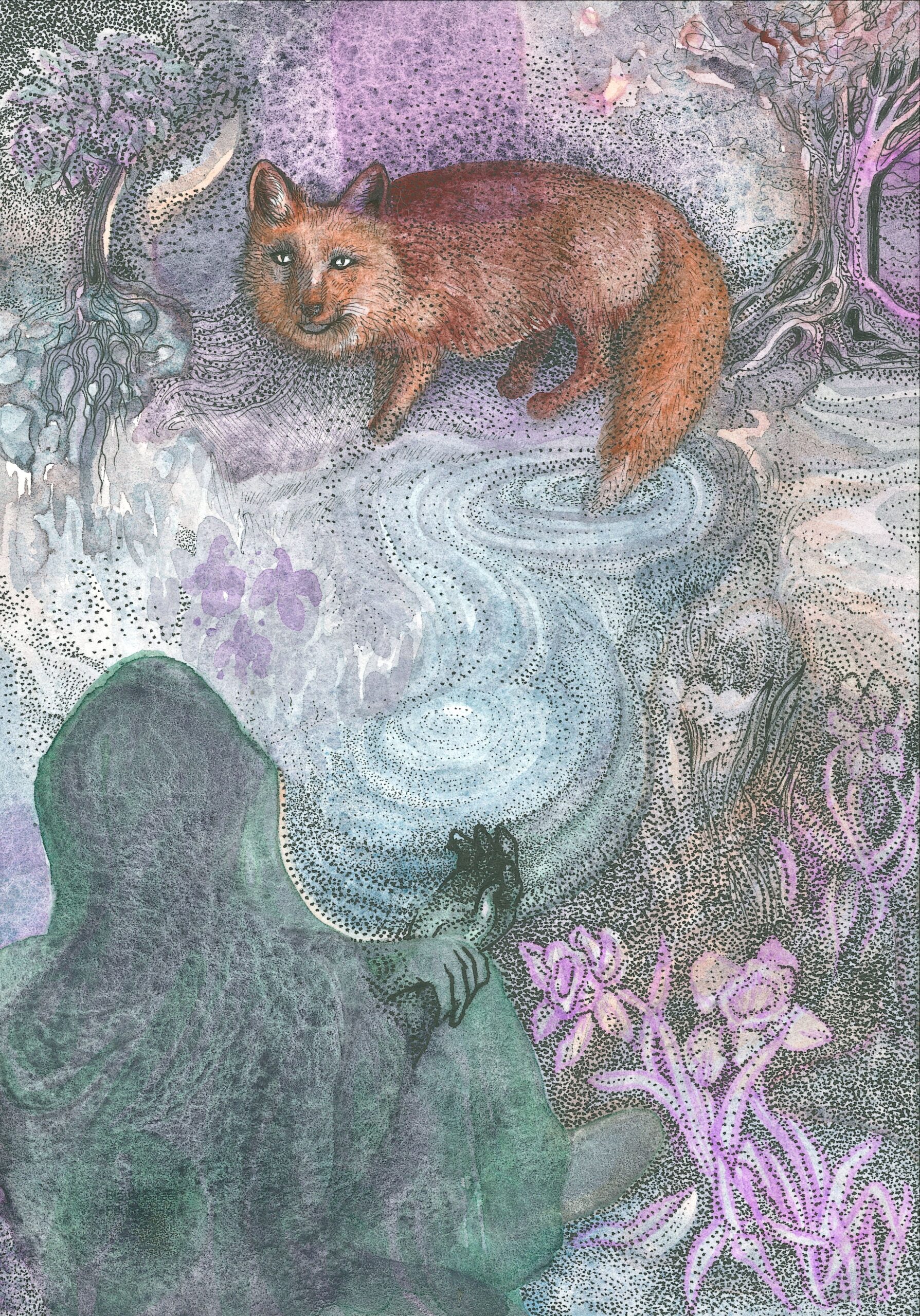
At the back of the garden, past the Virginia creeper-garlanded and squirrel-populated shed, he pushed through the gap in the hedge to the graveyard, hearing “Take two cows, Taffy” carrying in the breeze as the wood pigeons gave their dusk chorus.
It was Rhiannon’s rhyme. She used to sing it half in English, half in the language her mother had raised her in, back when the two of them still shared a bed and a kettle and the small, ordinary economies of a marriage. Cadno, she called the foxes, the southern word, warmer in the mouth than its northern cousin. She told him once, not quite meaning it, that in her grandmother’s telling the fox was a guide between the worlds of the living and the dead, an omen dressed in fur, welcome at a grave the way it would never be welcome at a hearth. The marriage hadn’t survived the years, but the rhyme had outlived it, arriving in his mouth now, unbidden and borrowed. Cadno, the harbinger of change, a psychopomp between realms.
… in her grandmother’s telling, the fox was a guide between the worlds of the living and the dead, an omen dressed in fur …
He watched in the dew-dark as sleek amber forms glimmered past the graves, their bright golden eyes momentarily catching his gaze with a gilded understanding. The foxes’ eyes were deeply searching, fathoming his years that were etched and scored, like concentric tree rings, with great tragedy, sacrifice and displacement, which he tried so hard to disguise.
He thought of where he had left, the foothills of the Zagros mountains (not letting himself name those mountains, even in his own head), a place that had learned to measure time in convoys and curfews before he was old enough to measure it in anything else; of a home that existed now only as a shape he redrew each year with less and less confidence in the lines.
Rhiannon had asked about it with quiet fascination, and he had never offered much; perhaps that taciturnity was one of the reasons the marriage had thinned out the way it did. There were two kinds of exile—hers, inherited and folkloric; his, recent and unspeakable—never quite finding a shared language, even in a language they both spoke.
“I have fled as a fox, used to concurrent bounds of quirks,” Taliesin, the legendary bard of The Mabinogion, once regaled. And he too had fled, seemingly shape-shifting and becoming a different person after his exile, having hid under a dead friend’s body in the dark shadow of the mountains to avoid discovery by the army. A folkloric tale in the magnitude of its brutality, but true, and only unwillingly imparted after a violently rousing nightmare he had, as she lay beside him.
He stepped back as the foxes approached the daily morsels of vegetables and bread, watching from the jittering of the hedgeline, before they pranced back into the night. Some evenings, their plaintive screeching would sound between the street-lamp fizzles and occasional sirens, in the soporific dusk of suburbia, a sermon to the night—and he would answer it very quietly, in his heart, in the words of the rhyme begun forty years and borders ago. At school, his moniker was رێوی – rêwi – meaning fox. Another child had jostled him one day, saying, “What’s up, fox?” and the name had stuck, reflecting the secret cunning of his eyes.
… his nightly ritual remained unchanged, a timeless dance between him and his vulpine friends, as unmoved as the gravestones …
As the seasons changed, so did the garden, a Constablesque carousel of changing fractions of light and blurry shades of green. Yet his nightly ritual remained unchanged, a timeless dance between him and his vulpine friends, as unmoved as the gravestones, more unmoved than the borders he had crossed, than the country that no longer answered to the name he called it by.
His constancy, like the foxes’ nightly emergence, was a thing of beauty in a city so obsessed with treadmills and tail-chasing. His eyes distilled the Milky Way and his clear, knowing smile as he caught sight of them shone calm as a mountain tarn. For him, the enchantment of this dance lay not in the spectacle itself, but in the simple act of giving and receiving, of forging connections that transcended barriers of species and circumstance, of country and of tongue.
Beneath the charm of the stars, he made a picnic of love and wonder—one he could understand, with flatbread torn the way his mother once tore it in a kitchen an ocean and a war away, vegetables set down like an offering—a testament to an enduring bond of shared kindness and to a borrowed rhyme still travelling, fox to fox, garden to garden, further from the two homes that cherished it than it was ever meant to go.
The title of the story is drawn from Joy Williams’ novel, The Quick & the Dead.