A rare example of polyandry
Draupadi’s marriage is a rare example of polyandry in Hindu stories, as she is obliged to marry the five Pandava brothers. Initially, it is only Arjuna who wins her hand in a svayamvara—a public ceremony wherein a woman of high status chooses her own fiancée from a group of potential suitors in a competition—organised by her father, King Drupada. However, when Arjuna returns home with his bride and his four brothers, he announces, “Mother, look what gift I’ve brought home,” to which his mother replies, “Whatever gifts you’ve brought must be shared with your brothers,” before realizing Arjuna was talking about Draupadi. After they consult with a sage, the marriage is blessed and they move forward with it.
It’s unclear how much say Draupadi has in this arrangement. Is she excited at being the wife of such noble brothers? Surely there would have been some discomfort at the unconventional polyandrous relationship. Not only does she have five husbands, but they are also brothers who share one wife. Did the Pandava brothers have to accept the wishes of their mother, who spoke out of a misunderstanding? How far does the notion of “doing as your parents wish” go here? What role does Draupadi’s honour play in this situation, in following her mother-in-law’s order, or in having five husbands? In the end, Draupadi goes along with the arrangement.
Not only does she have five husbands, but they are also brothers who share one wife.
One of the most arduous parts of Draupadi’s story unfolds in the courthouse of the Kauravas. The five Pandava brothers are lured to the palace of their uncle Duryodhana, King of the Kauravas. There, trapped and in a state of despair, the Pandava brothers fall into a gambling addiction. King Duryodhana takes advantage of their vulnerability and tricks the brothers to gamble away all their possessions, even their own freedom. Offering the brothers a last attempt to win everything back, Duryodhana suggests that they gamble their wife, Draupadi, to which they agree. Unfortunately, they lose once again.
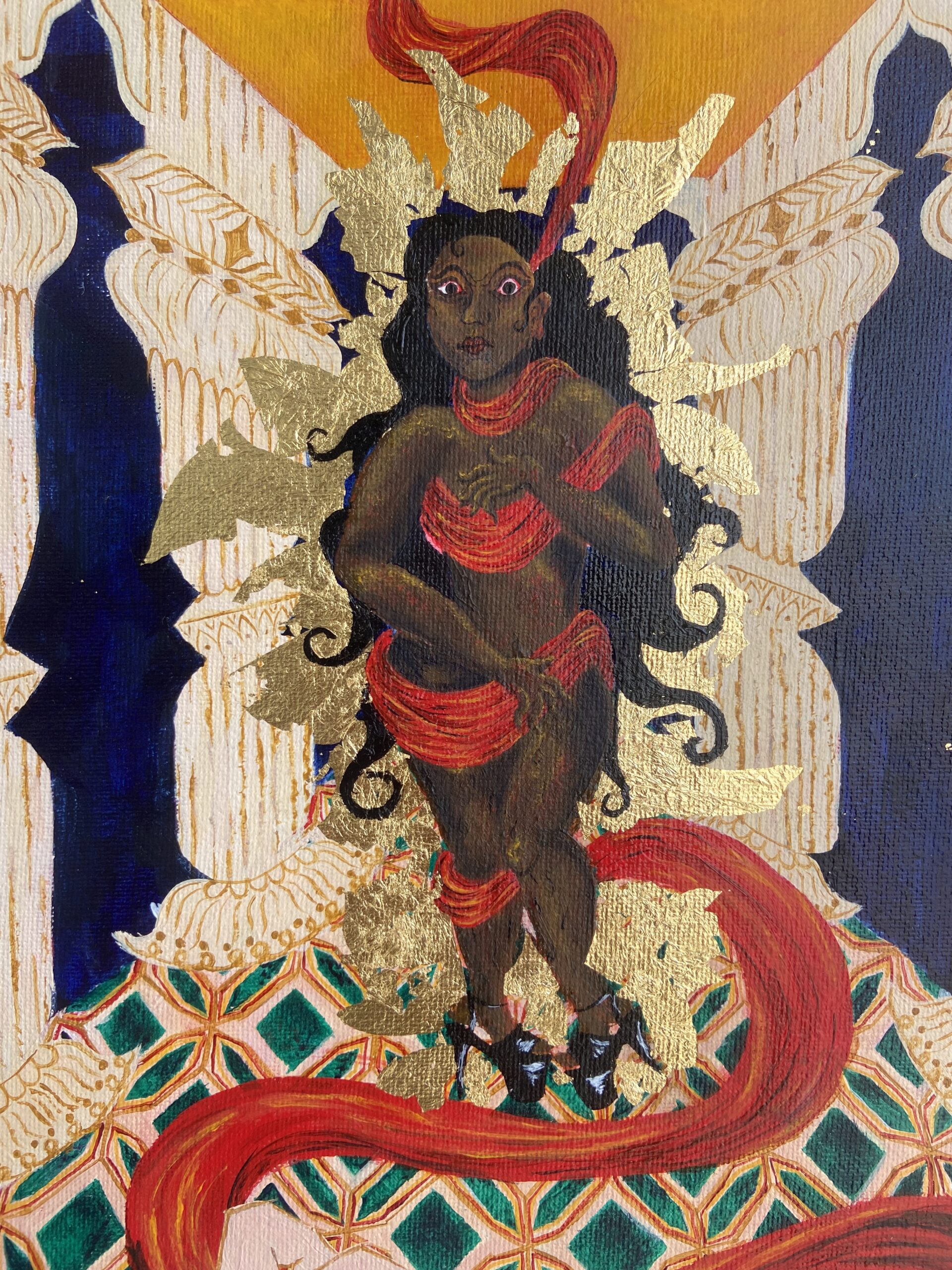
King Duryodhana orders his brother to bring Draupadi to the court. When Draupadi refuses to come, he drags her by her hair into the royal courthouse. There, Draupadi challenges the king’s winnings, insisting that since her husbands had already lost their freedom, they could not then gamble her away. Enraged at her refusal, Duryodhana shames her for her polyandrous marriage. He proceeds to order for her to be forcibly disrobed, as a further act of public shaming. Duryodhana’s brother tugs at her sari. He pulls and pulls and continues to pull, to no end. He pulls until he is exhausted and his muscles are sore. In a miraculous turn of events, the sari has become endless.
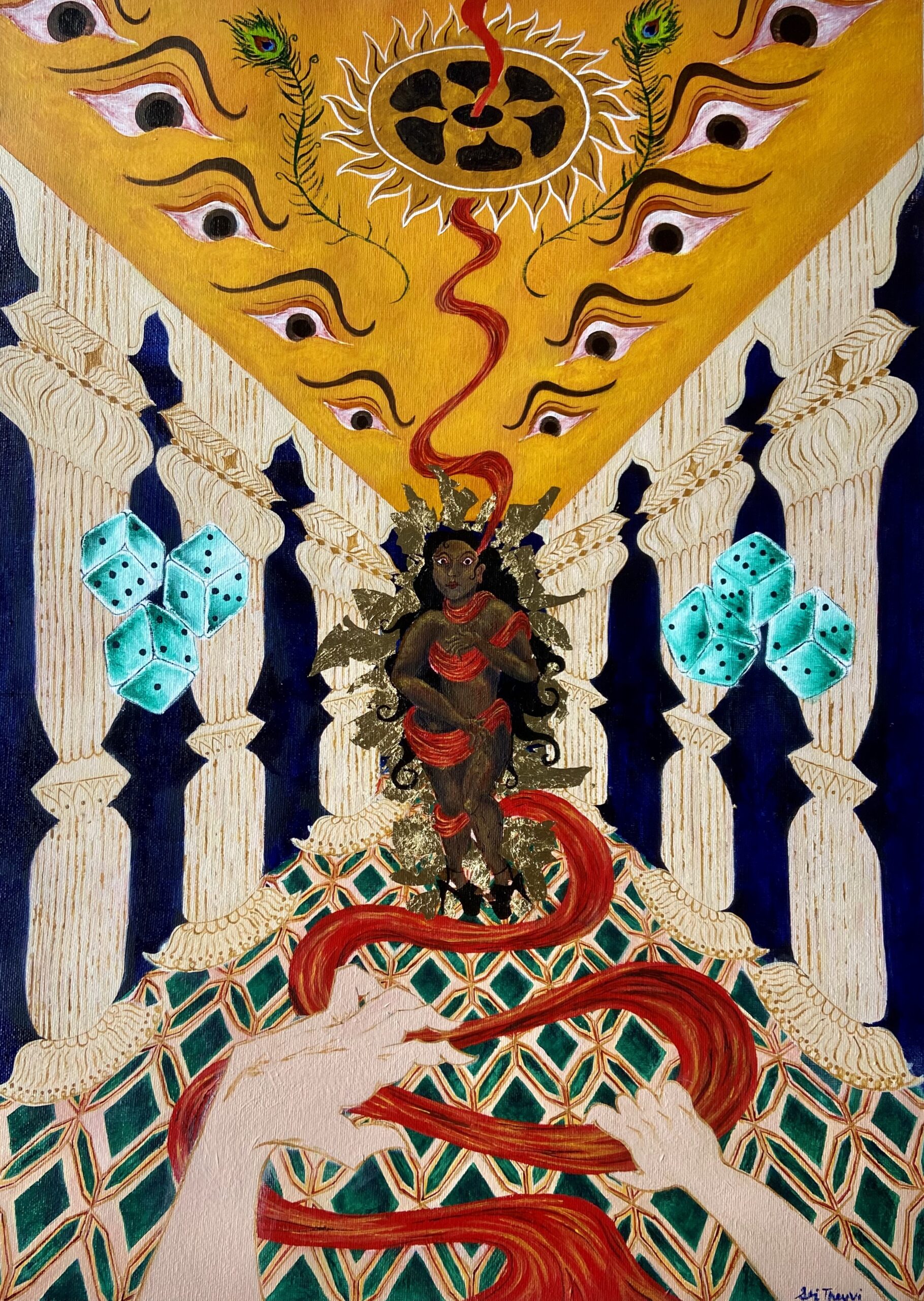
Some versions of the story say that, in that moment, Draupadi prays to her dear friend Lord Krishna, whose divine intervention protects her. It should not be forgotten here that one of Draupadi’s names is Krishnaa herself.
Up against all these so-called powerful royal men, Draupadi claims her own power. Even when her own husbands could not protect her, Draupadi protects herself. She uses her intelligence to challenge the legality of Duryodhana’s gambling, raising relevant arguments against his winnings. So many representations of Draupadi’s disrobing show her as a helpless, frightened woman. However, this does not need to be the story of Draupadi’s shaming; it can be the story of Draupadi’s refusal.
This event of public shaming is the triggering moment for the famous Mahabharata war, pitting the Pandavas against their cousins, the Kauravas, where the wisdom of the Bhagavad Gita is recited by Krishna on the battleground. An important reason for the Pandavas going to war against their cousins is to seek revenge against what the Kauravas did to Draupadi.
Draupadi vows never to wash her hair until she could wash it in the blood of Duryodhana.
In the years of exile of the Pandava brothers, Draupadi vows never to wash her hair until she could wash it in the blood of Duryodhana. Draupadi is not a helpless woman. She is fierce, intelligent, quick-witted; she is, as so many of us are often called, a problem woman.
Draupadi’s story is often framed as the story of ultimate shame: Wife to the five Pandava brothers, none of whom could protect her. Shame is a powerful social weapon, and Draupadi refuses to be shamed.
And, how does this relate to you?
This is the story of every unwanted girl-child, of every daughter a burden to her parents; of every bride shipped off to her in-laws. This is the story of your sole purpose being to get married off. This is the story of honour killings, of the weight of ~duty~. This is the story of every newlywed headline of horror. This is the story of the menstruating body having to sit out the ritual. This is the story of telling you to cover up and sit proper. This is the story of sluts and whores. This is the story of being too hairy, too fat, too sexy. This is the story of the BROWN. MALE. GAZE. This is the story of every time they put their hands on you and tell you it was your fault. This is the story of silently carrying the family. This is the story of objectification, of violation, of someone else’s shame being vomited onto you. This is the story of the feminine body as everyone else’s playground.
And this is also our refusal of that story.
THIS is the story of Panchaali.
This one is called “Have You No Shame?”