Beautifying the body as an expression of the divine
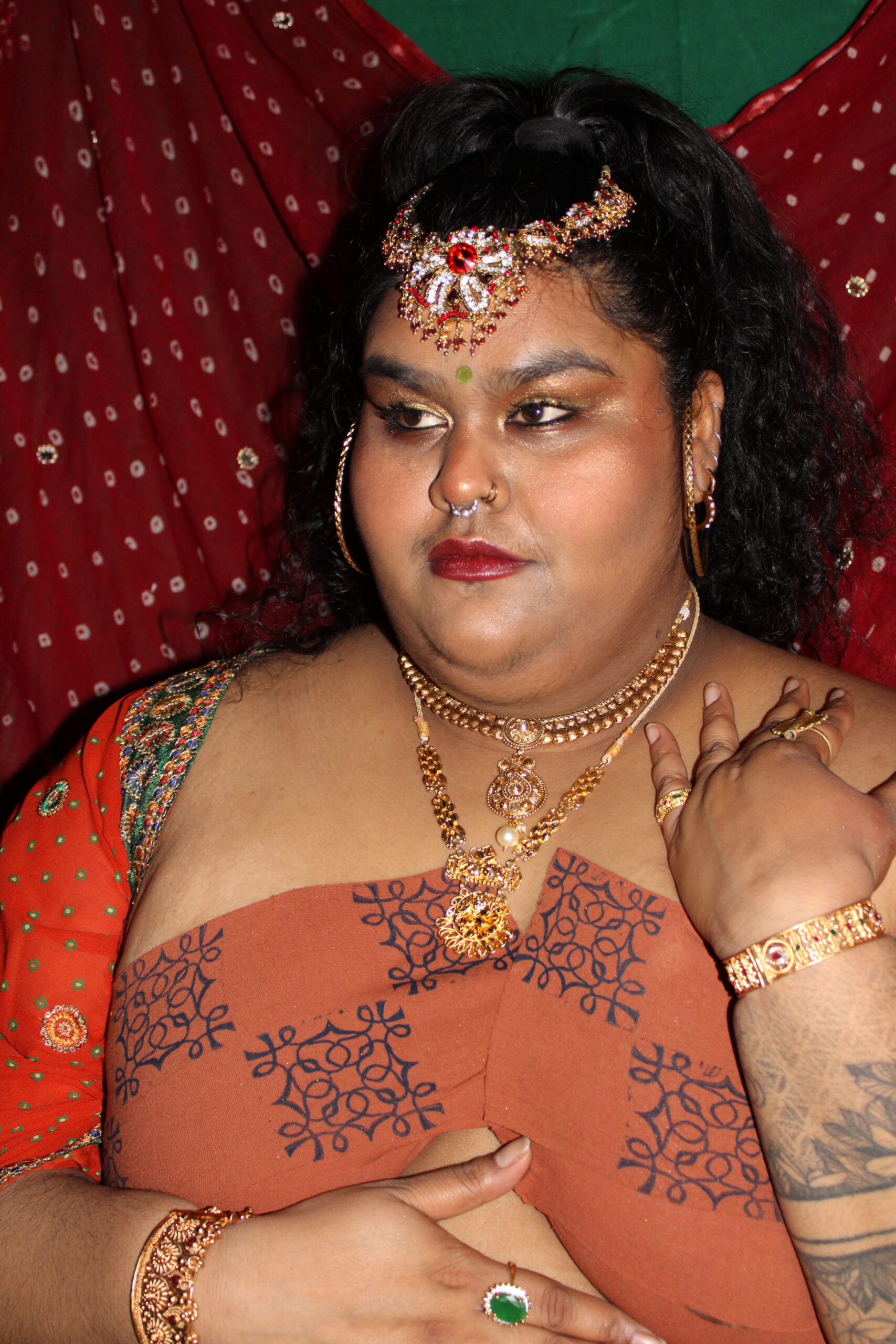
In the tradition of Krishna and Shringar bhakti,* adornment is a practice of devotion and of revering God present in oneself. This spiritual practice is particular in that it locates the divine experience within the physical and sensorial body rather than outside of oneself or in an ascetic experience, in comparison to many Abrahamic traditions that see the body and its felt experience as a ground for punishment and enforced compliance, and as a setting for sin.
As a devotee of Krishna and Shringar bhakti, a part of my practice involves beautifying the world around me, making myself into something beautiful, imbuing everything with beauty, in order to not just be physically beautiful, but to live a beautiful life.
In line with Indian art philosophy, beauty here is considered as an embodied state in the sensual realm, where following one’s pleasure is a guide to ascension. Not in a hedonistic way, but in a grounded and true way that affirms one’s Self within the collective. Indeed, Vatsayana, in his ancient work, the Kama Sutra, explores the art and practice of adorning another as an act of love. This practice is observed as the story in many paintings in South Asian art history.
The Kama Sutra explores a similar concept known as Alankara, or the art and rituals of beautifying and adorning oneself and one’s partner as an act of love and devotion. Alankara is an intimate and sensual practice that affirms one’s body and devotion to the divinity within, and with each other in the partnership. It challenges more puritanical hesitations around vanity and desire as being sinful, and instead proposes beauty and desire as embodied states to be nurtured and sought after, as a path towards spiritual enlightenment.
Trans people have known this all along…
There is spiritual knowledge to be found within the body itself, not just in the mind. Trans people have known this all along, bending, shaping and adorning their outer bodies to reflect their inner worlds. The trans experience in itself is sacred and transcendent, surpassing mere language and surface qualities. It is an embodied experience—an experience shared among us that can only be understood through lived experience. It is through an attempt at making this experience visible through bodily modifications and adornment that we can signal to each other and share a passing nod that we know this experience too.
Adornment as armour
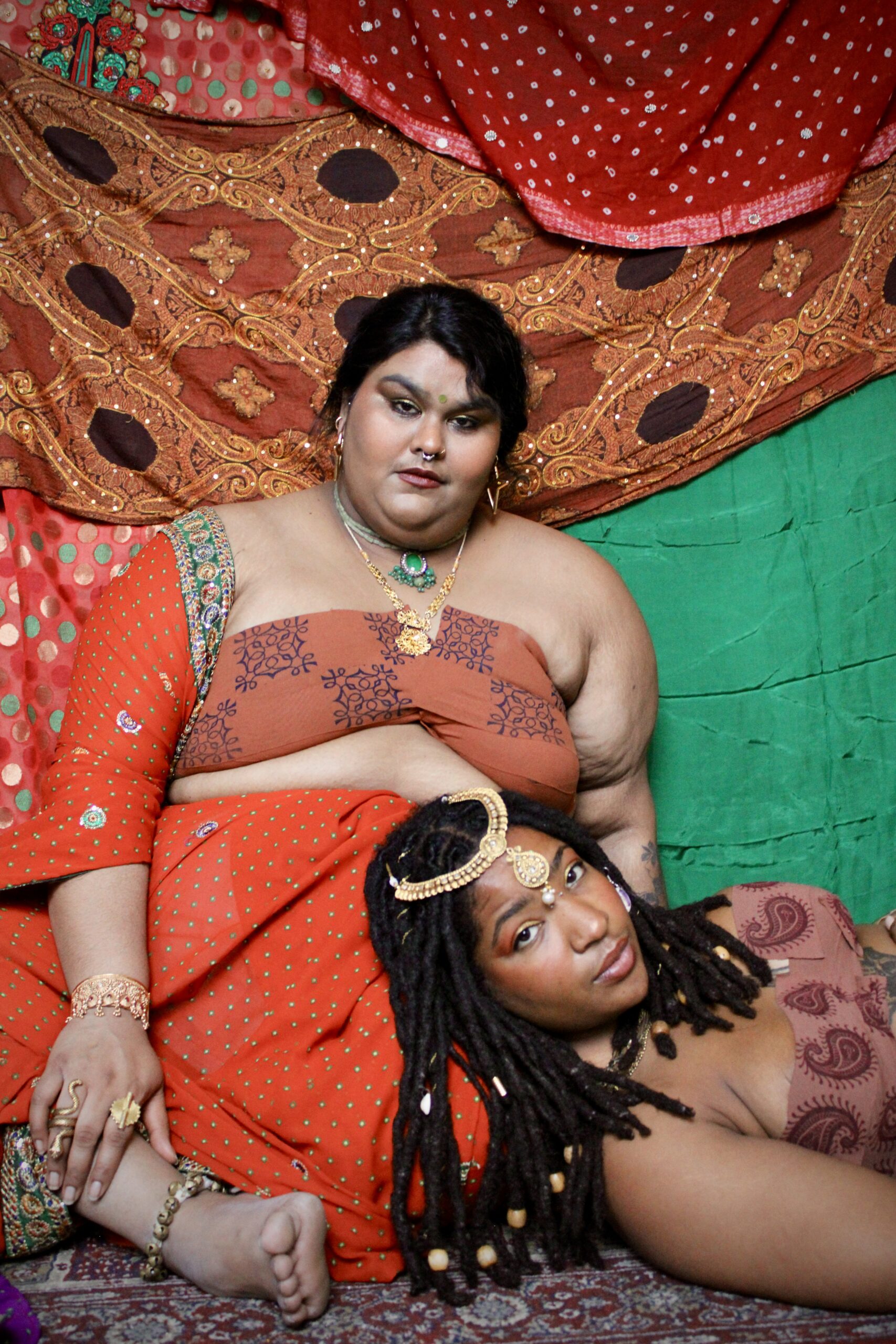
This project titled “Adornment as Armour” explores how people use rituals of bodily ornamentation as both protective mechanisms and social identifiers. More specifically, how the ways we adorn ourselves disrupt the social fabric of our world—from men wearing nail polish, to accessorizing with a keffiyeh; from using a single safety pin to hold an entire saree together, to trans people wearing gender-affirming gear and clothes.
I wanted to explore how women who were indentured servants wore their adornment as their currency; how some South Asian women are still not allowed to hold jobs, yet have vaults filled with gold as their financial security; how getting noses and lobes pierced is a rite of passage for the hijra. How do adornments add to our sense of Self, and what do they signal to others? What are the consequences of making ourselves more visible?
Adornments are shared by yet specific to different communities, cultures, tribes and religious groups, and are not always visible to outsiders. How do we communicate to the in-group, to those who speak our same visual language?
Traditional methods to break new ground
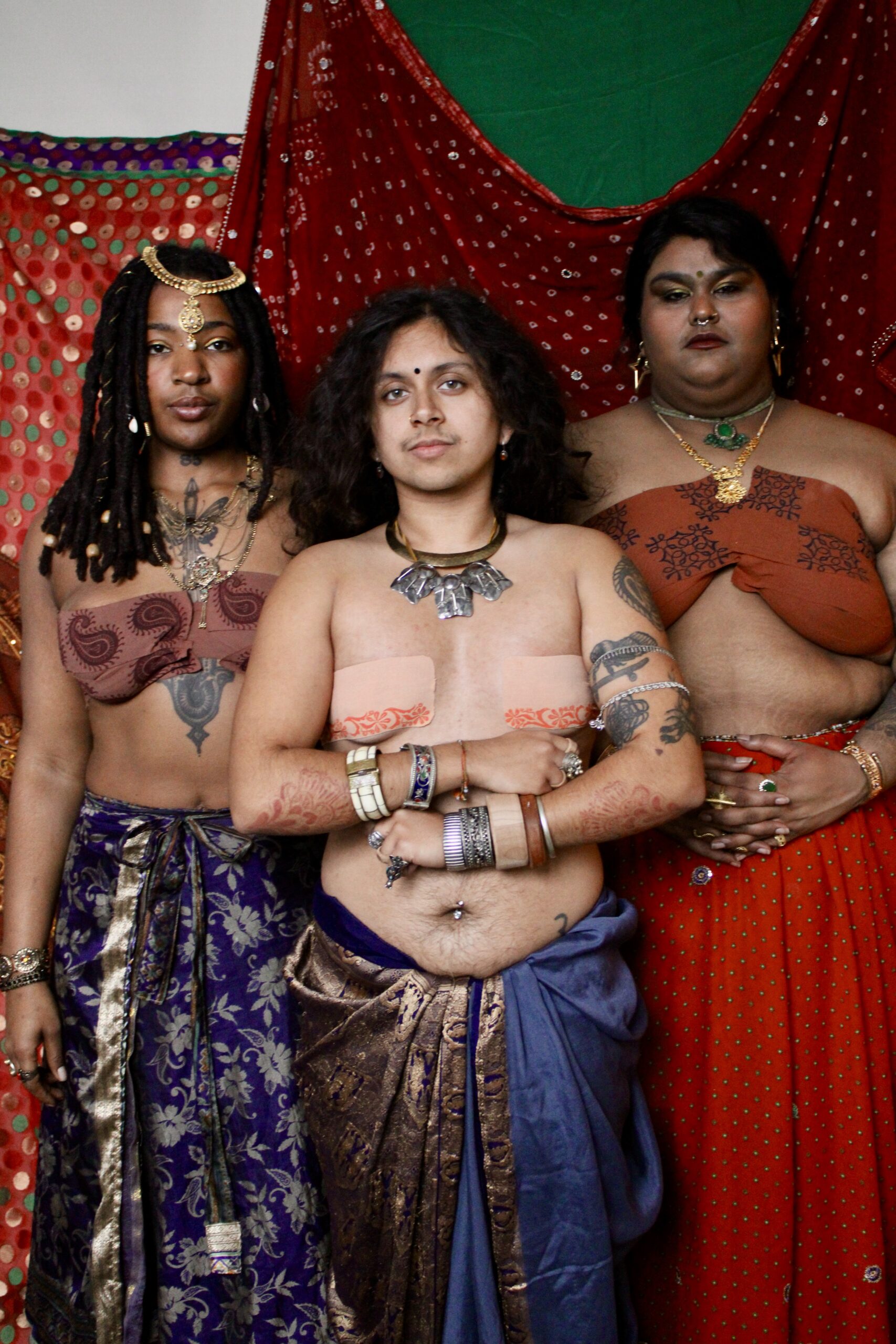
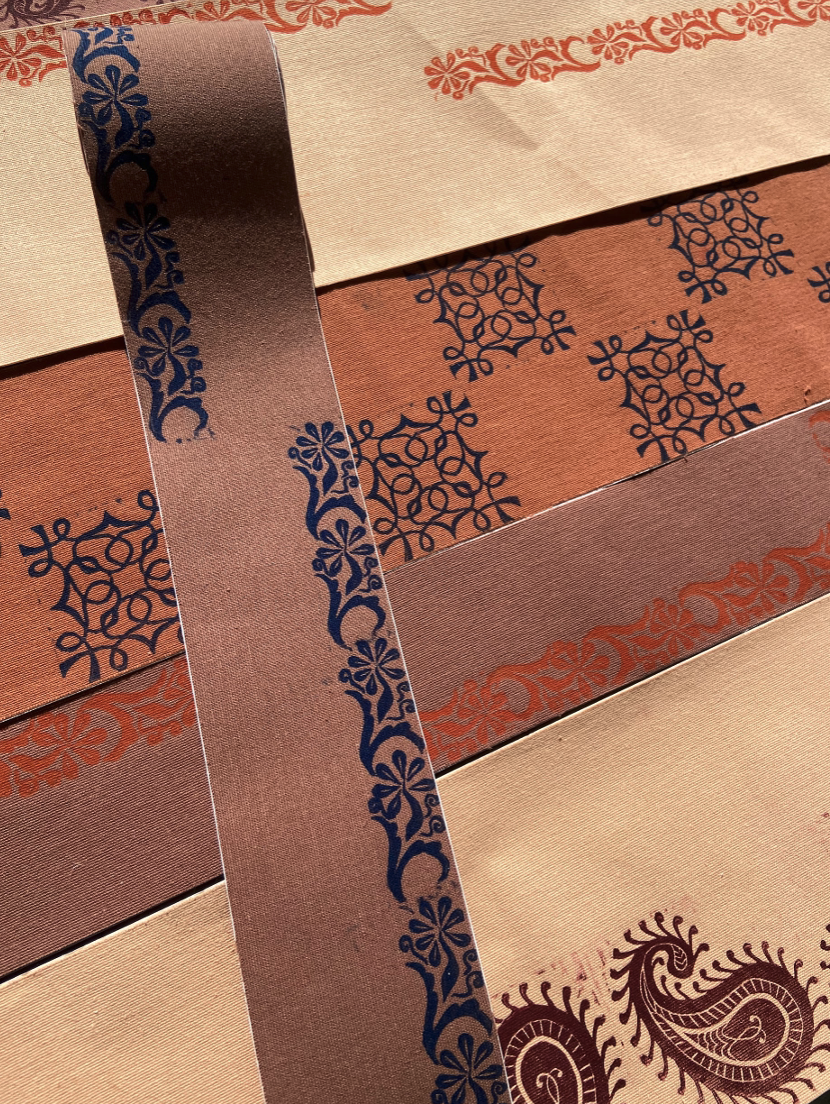
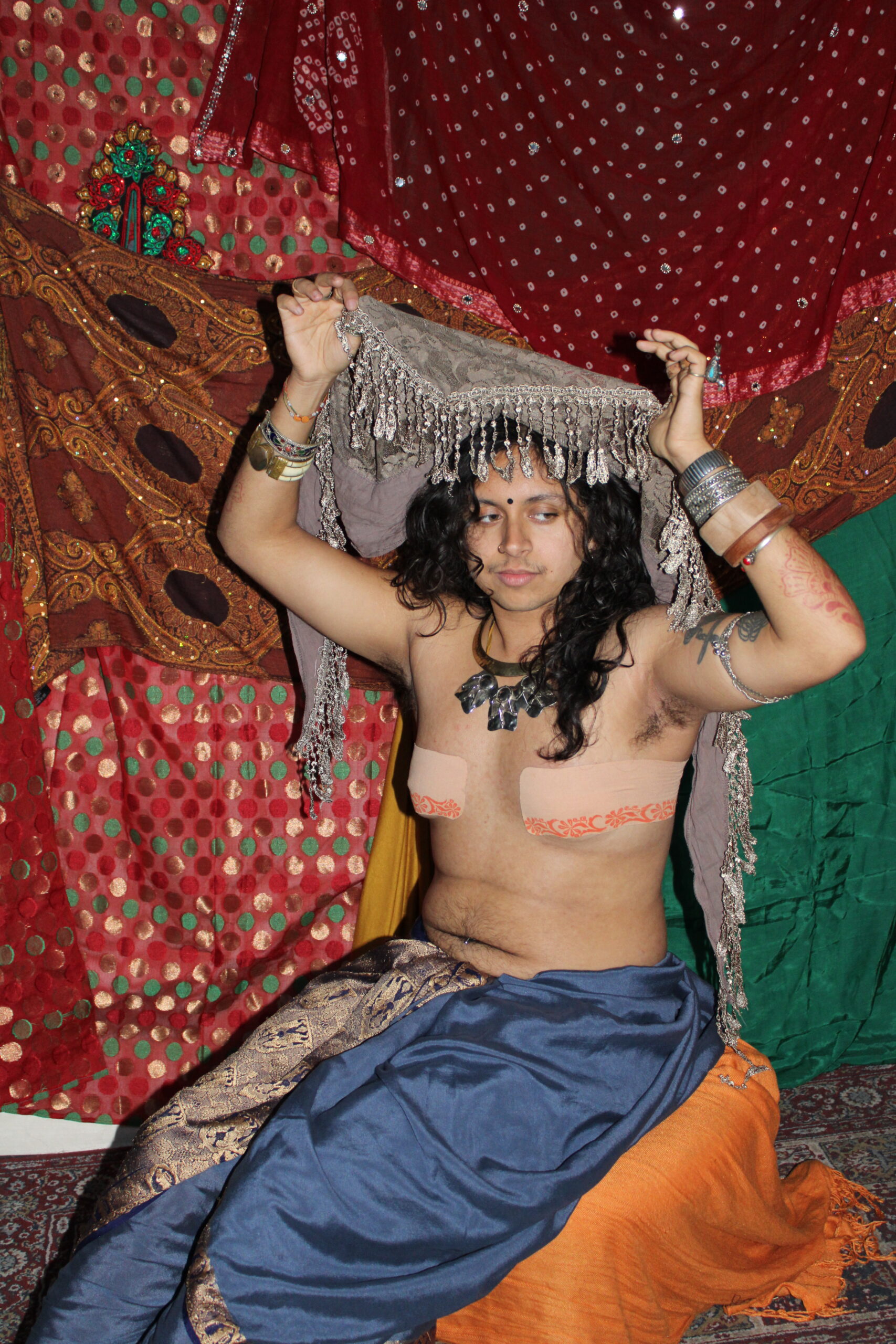
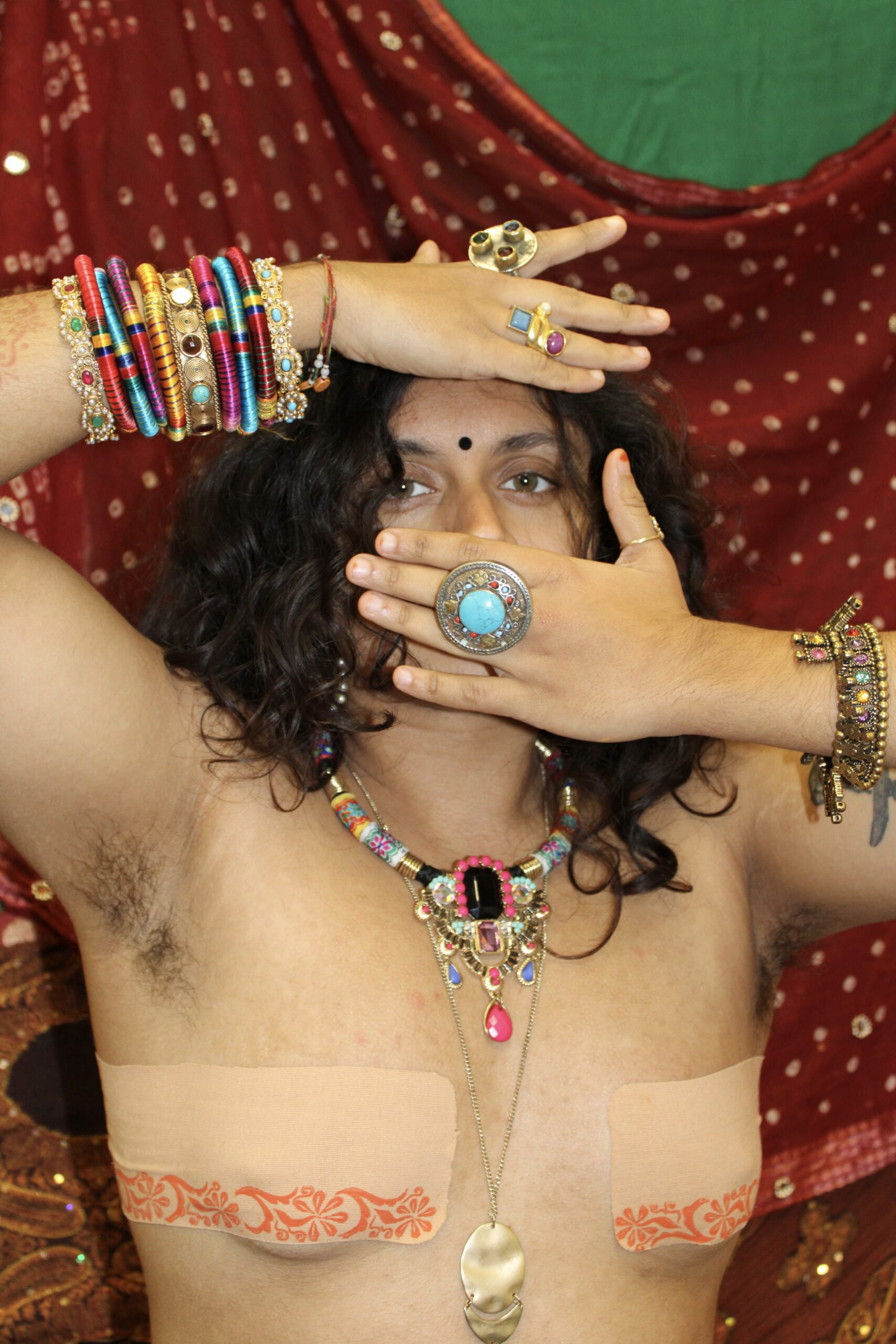
The project involves block printing on trans tape, a specialized medical tape for gender-affirming purposes, which is used by transgender and non-binary individuals for chest binding. It combines South Asian passion for beauty through adornment, with gender-affirming gear.
More specifically, I wanted to use the traditional Indian method of block printing on the unconventional medium of trans tape, in order to make beautiful an item that is usually bland and sterile. In the same way that jewelry in South Asia is a social signifier, trans tape is a way for trans people to affirm their bodies and feel more comfortable in the world.
This project came to be through my own experiences of wearing trans tape. Often when I would bind my chest using trans tape, if the tape was visible, I would receive invasive comments and questions. I wondered how it would be if I could beautify it and make it more visible, and wear it as both gender-affirming gear and an accessory—would it change the way I wore it? I wondered how the trans tape would transform from its purpose. This is in line with South Asian aesthetics; we are known for our maximalism. Why not make medical gender gear into something of an accessory?
When stories of transgender people are told, they are often about struggles—to fit in, to be accepted, to receive the care they need—or stories of medical violence, to name a few. Like the trans tape we use to bend our bodies to our will, these stories are bland and flat. They don’t do justice to the rich, complex and rebellious lives we live.
On “passing” vs. leaning into our identities
When it comes to the issue of fitting into a heteronormative, cisgendered society, I don’t think we fit in. I believe, instead, that we should lean further into our identities and express ourselves so unapologetically, so obnoxiously, that the world can no longer refuse us.
I believe that making the mundane (medical, gender-affirming gear) into the sacred (bodily adornment and ritual) is how we, as trans people, can affirm our own selves in a world that continues to deny us.
I believe the power is in our own hands, actually.
Models’ perspectives
Marie
J’ai cru, durant les prémices de mon cheminement identitaire queer, que pour être non-binaire, j’avais besoin de me dessiner une moustache lorsque je portais des robes.
J’étais coincée dans l’ambivalence binaire du genre. Mon « paraître » façonnait mon être.
Mon « paraître » façonnait mon être.
Finalement, j’ai compris que je préférais flotter au-dessus du genre.
Être non-binaire, pour moi, ce n’est pas habiter un entre-deux figé. C’est me permettre d’être mouvante, contradictoire. La non-binarité m’a rapprochée d’une forme de liberté. Elle ouvre un espace à la part de moi qui veut simplement exister.
Et même si je ne peux me dissocier de mon identité de femme noire – non pas seulement façonnée par les réalités qu’elle traverse, mais aussi par ce qu’elle signifie pour moi ancestralement – la non-binarité fait vivre en moi une part qui existe en dehors de toute temporalité et de toute corporéité.
Jaadu
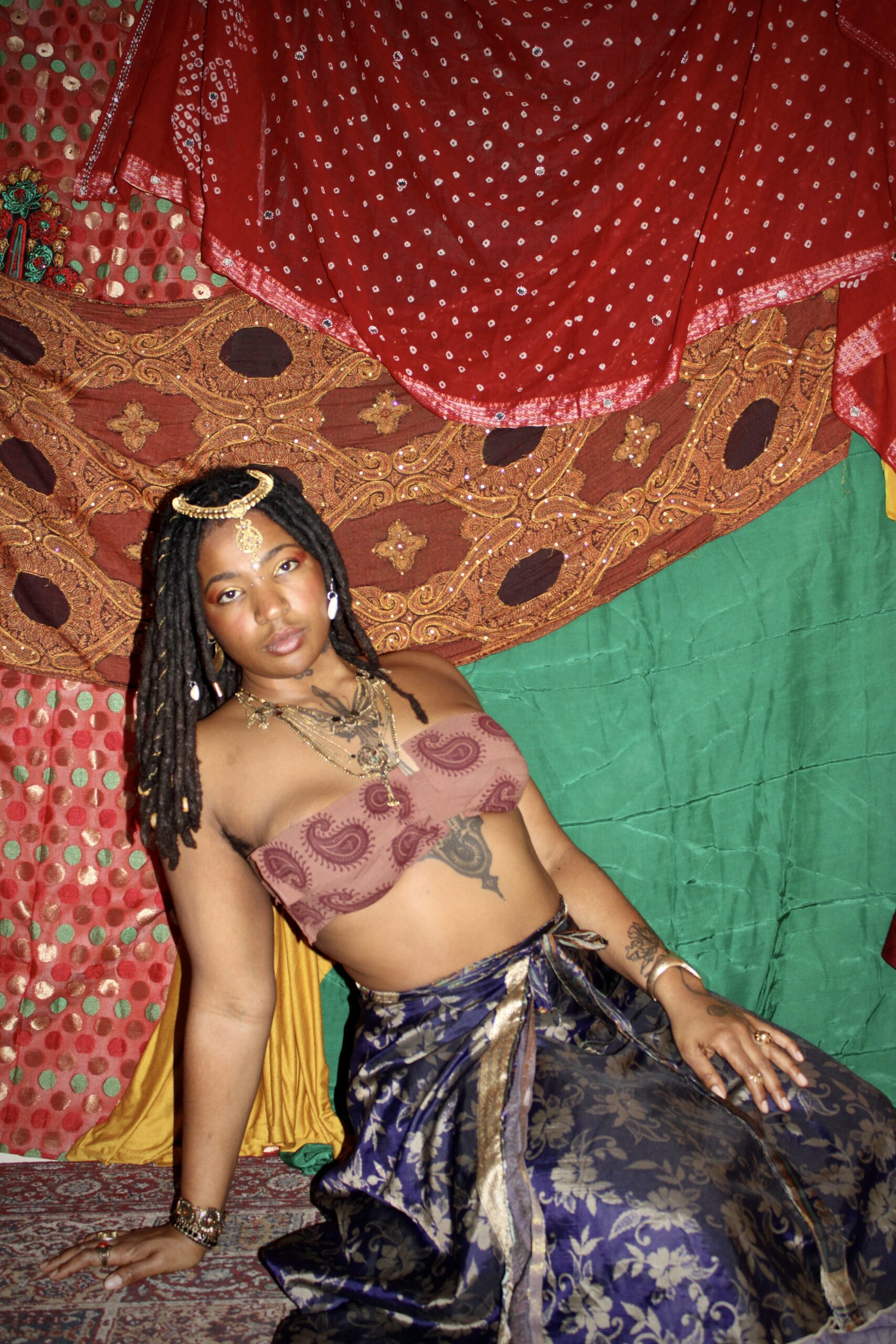
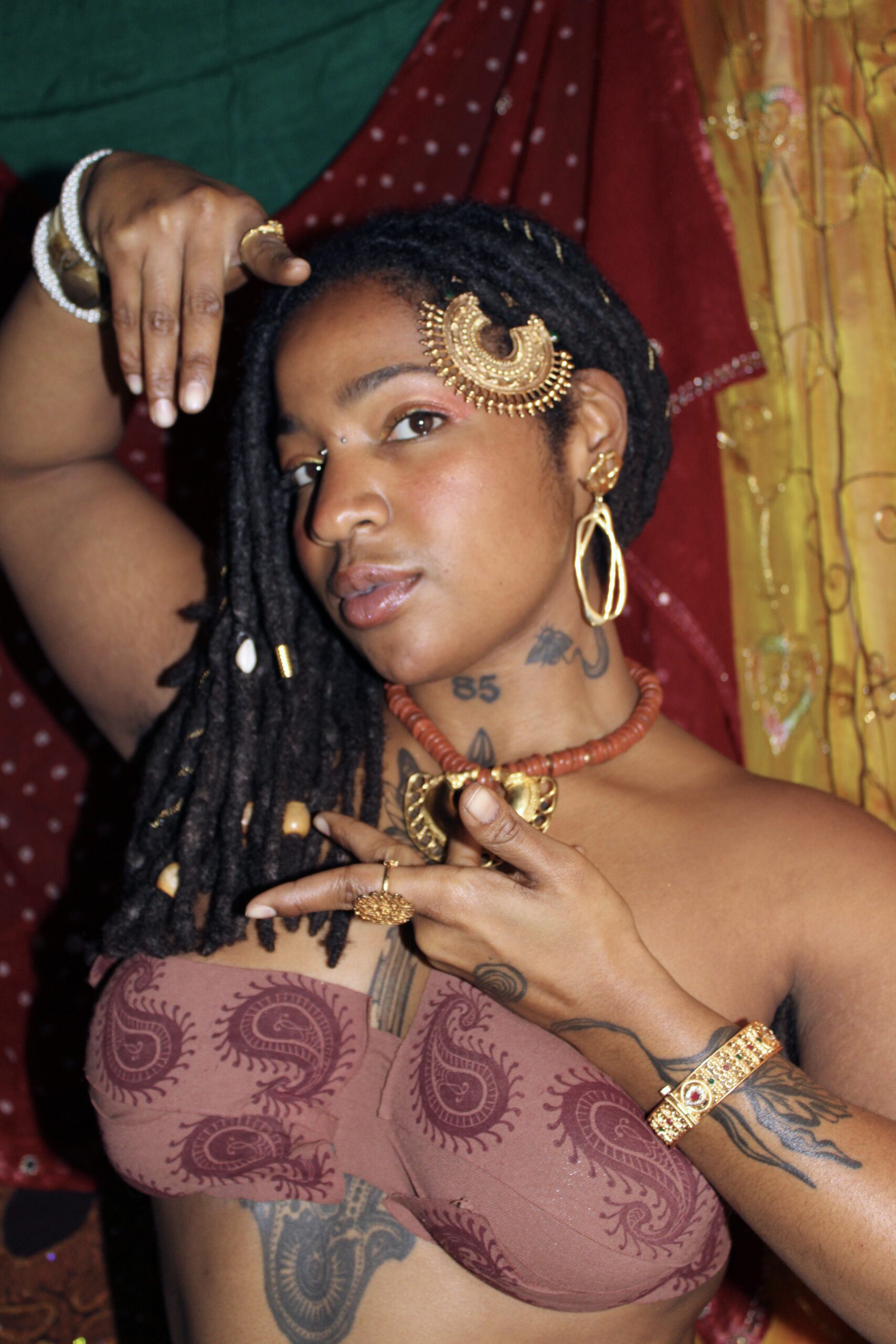
Being trans feels like the most normal thing in the world to me. It feels like an old truth of my being, colouring the way I’ve existed in the world since birth. Even before finding the words, trans children are often raised and exist as third genders from an innate inability to conform to gender expectations. It’s strange because on one hand it feels aggressively normal because it’s all I’ve ever known, but I’m realizing more and more how it’s made me exist outside of society.
I’ve been on HRT for 5 years now and don’t consider passing to be a specific priority for me (but more and more it feels like I should try harder for safety purposes). I know everyone knows about the bathroom problem or whatever, but I think people seriously misunderstand what the problem in question is.
It’s not that my conception of my gender is so fragile that I need the bathroom sign to validate me, it’s that I’ve been assaulted in men’s bathrooms, and had security called on me in women’s. It’s that regardless of where I go there’s a chance I will face some kind of violence for going to the bathroom unless there’s a sign to tell cis people that they don’t have to care about my genitals.
It’s that when I was looking for resources on navigating bathroom assaults as a trans person, all I found were people talking about the theoretical fear of a trans person assaulting them in the bathroom, despite the opposite situation being significantly more common.
Our beauty is transgressive; you have to forget what the world has conditioned you to value, to see it.
I spend most of my time around queer people, but when I’m not, it’s really obvious often that I’m being perceived as a freak of nature. On the other hand, people also tell me often that I’m beautiful. It’s weird to hold these two truths. There’s an intense dichotomy of how my being is perceived in the world, and I feel that’s the case for a lot of trans people. Our beauty is transgressive; you have to forget what the world has conditioned you to value, to see it.
Bindi
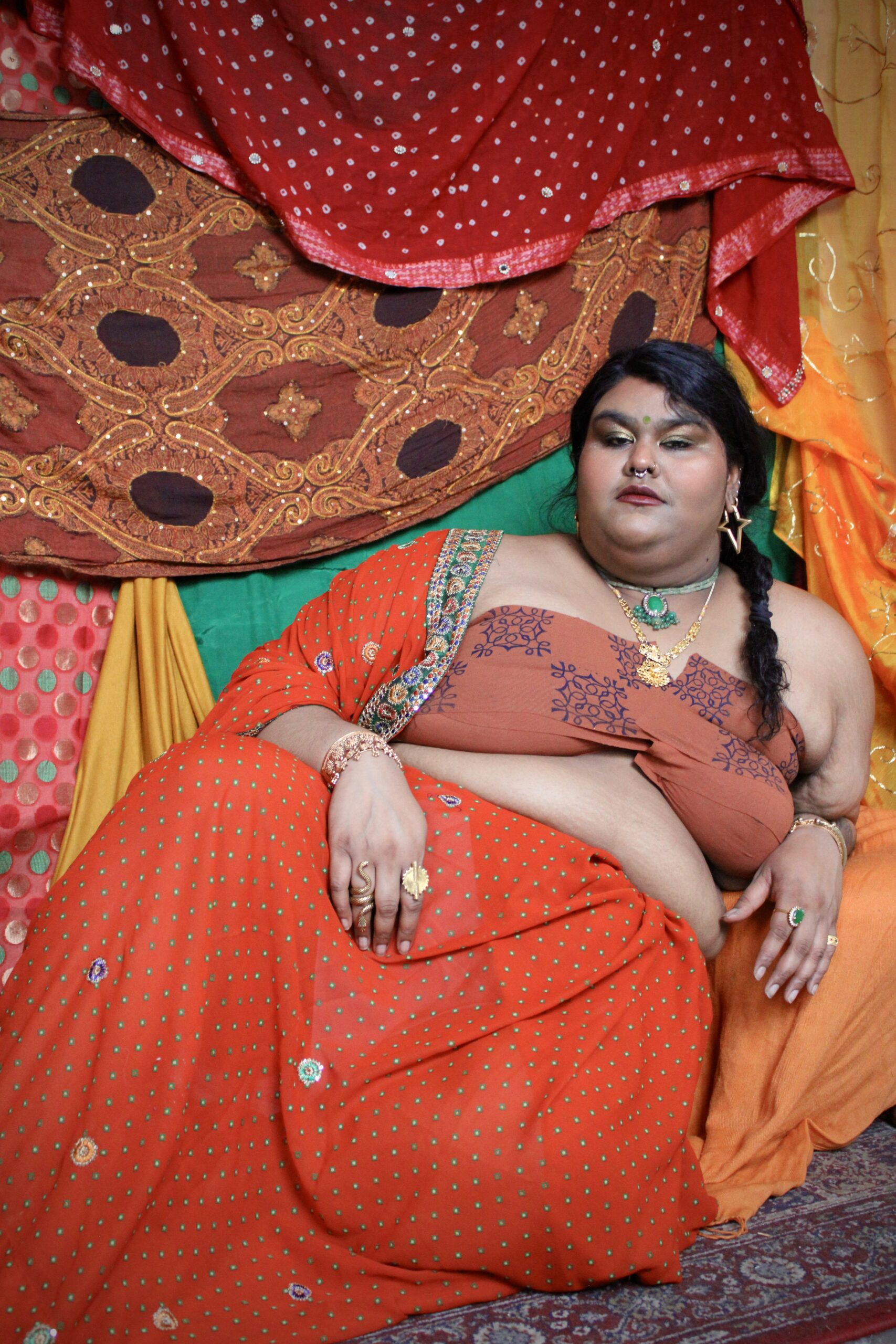
I think, for me, what I’m noticing more and more, is that it gives me the opportunity to live aligned with nature and energy and human beings. It gives me freedom to be able to embrace the energies around and to be able to flow. It’s not even that my body is different, it’s not even that… it’s beyond my body. Spiritually, it connects me to everything and everyone and I think it’s quite beautiful to be able to give yourself that freedom to be able to be and to just flow and it’s very fun.
It gives me freedom to be able to embrace the energies around and to be able to flow.
*Notes
The spiritual tradition of Krishna Shringar centers on loving devotion to Lord Krishna, usually practiced through the embodiment of love, pleasure, beauty and the erotic. At its heart is Krishna as his incarnations in the Bhagavad Puran and Jayadeva’s Gita Govinda. These texts tell of his mischievous adventures in Vrindavan and his love with Radha.
Shringar rasa is a philosophy in Hinduism and one of the main rasas* in Indian aesthetics, where beauty is equated with divinity, and beautification of the body acknowledges the divinity within it. Krishna Shringar is a combination of rasa and bhakti.
Bhakti is loving devotion towards a God, usually through an artistic medium.
Rasa, in Sanskrit, means juice, essence or taste. In Indian art, rasa is the basis of aesthetic theory, signifying the embodied feeling of the viewer upon experiencing a piece of art. Here, the artists’ responsibility is to evoke a heightened felt experience in the audience. Indian aesthetic theory “was founded upon representation of human emotion in the literary artwork and our capacity not just to find the representation ‘beautiful’ but to get inside it.” (ed. Sheldon Pollock, A Rasa Reader: Classical Indian Aesthetics, New York: Columbia University Press, 2016, p. 2).