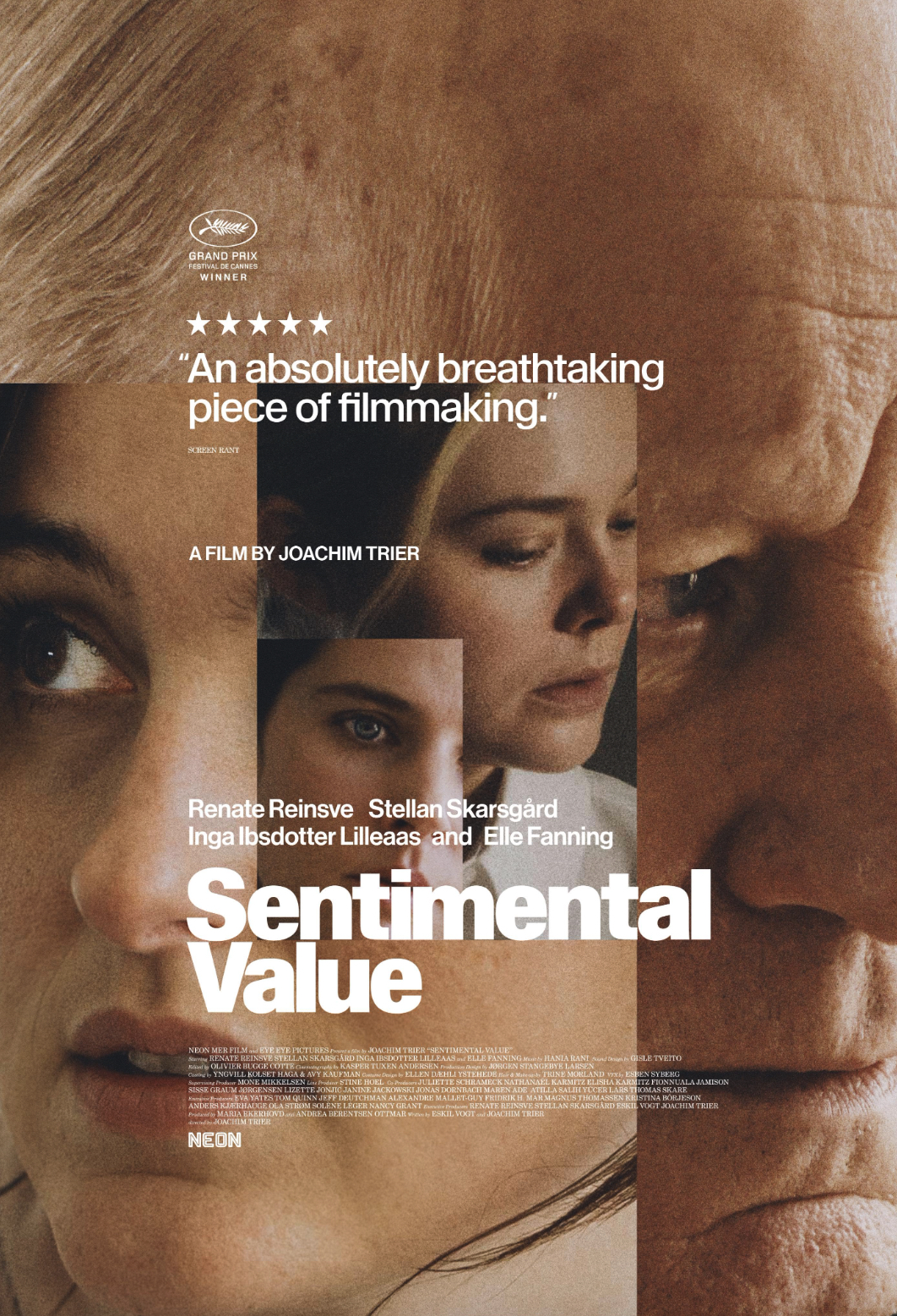
I watched Sentimental Value twice
The first viewing left me crying during scenes that were not conventionally sad, which only deepened my confusion about where the emotion was coming from. The film seemed to touch a nerve that exists beneath reason, a place where the body responds before the mind has learned how to interpret or contain what it is feeling.
When I returned to the film a second time, the tears were still present, but they were accompanied by thought. I found myself slowly stitching connections between my emotional response and the questions that occupy my personal and professional life as a researcher in bioethics and health law—questions about how trauma is inherited rather than contained, about how care is offered imperfectly and often too late, about how love is expressed obliquely through absence as much as through presence, and about how repair, when it comes at all, unfolds slowly and unevenly. Sentimental Value does not attempt to explain these things or resolve them into lessons. Instead, it sits with them, allowing discomfort and ambiguity to remain intact, and in doing so it creates space not for instruction, but for recognition.
There is a great deal I carried away from this film, more than can be neatly named. But if I try to give shape to what stayed with me most insistently, three themes rose to the surface again and again: mental health, intergenerational trauma and imperfect care. I found myself articulating this not in writing at first, but aloud, while trying to explain to my partner why the film had unsettled me so profoundly.
In speaking it, I realized that what moved me was not any single scene, but the way the film traced how pain travels, quietly, unevenly, across relationships, across time, across generations, asking what happens when tenderness is delayed, when it is offered after damage has already taken root.
This piece is an attempt to sit with the film as one might sit with a memory or a confession, to ask what it stirred, and why those stirrings feel so urgent now.
How we watch it is part of what it becomes
While watching Sentimental Value, I became sharply aware, almost mid-scene, that my own thoughts and emotions were not simply responding to the film. They were in some way co-creating it. The film on screen was one thing, but the film that formed inside me was stitched together with my own histories, my own preoccupations, my own wounds, my own theories of care. Maybe that is true of every film. A film is an ecosystem, after all.
I thought about this during the scene where Gustav is showing Rachel how to perform his most critical scene in one shot, when she stands, looks at her son leaving the house, and then ends her life. What is she thinking in that suspended second? What is she feeling?
My conception of this moment is shaped by who I am. My partner’s conception is shaped by who he is. And just like that, the film diverges into two different films living side by side, each equally real in the minds that hold them. I loved that the creators allowed this. They did not force a single interpretation into our mouths. They trusted us with the space. That trust, this invitation to co-create meaning, felt to me like one of the film’s quietest forms of care.
Tenderness is punk
At the Cannes Film Festival press conference for Sentimental Value in May 2025, director Joachim Trier described his creative position with a line that has lingered with me since: tenderness is the new punk. He framed it as both a personal and artistic stance, a belief that vulnerability, openness and emotional sincerity can be as radical today as punk once was in its moment.
I keep returning to that sentence, not as a slogan, but as a diagnosis. Tenderness feels radical today, not because it is new, but because it has been systematically unlearned. No one told us this outright, but schools, workplaces, families and cultural narratives have quietly taught us the same lesson: endure, perform, keep moving. Emotional restraint is rewarded. Vulnerability is treated as inefficiency or weakness. Over time, strength has come to mean self-containment, and tenderness has been reframed as something private, indulgent, or unsafe rather than as a legitimate way of being in the world.
This atmosphere shapes the lives in Sentimental Value. The daughters live inside this world, carrying its pressures alongside their family history. The film does not turn them into symbols, but it situates their private pain within a broader emotional climate. What happens in the family is intimate, but it is not isolated. The demand to hold oneself together does not originate only at home, even if home is where it cuts most deeply.
The daughters live inside this world, carrying its pressures alongside their family history.
This inheritance becomes painfully visible in Nora’s anxiety before stepping onto the stage, which is one of the first things the film asks us to sit with. Early on, we are made viscerally aware of what the demand to perform, to be switched on, ready, exceptional, does to her body. This is not casual nervousness. It is the kind of anxiety that tightens, overwhelms, and finally paralyzes.
Within the world of the film, this anxiety feels inseparable from her relationship with her father. Was it born from his absence? From watching her sister instead of her become the subject of his celebrated documentary, screened during a retrospective honouring his life’s work? From the slow realization that she was rarely, if ever, the centre of his attention? Perhaps it is all of these at once.
What matters is how that history settles into her present. Nora becomes a theatre actor, tackling a profession built on being seen, evaluated and judged in real time. And the need to do it well—no, to do it perfectly—does not liberate her. It curdles into something disabling. We see it in the moment when she tears at her costume just before going onstage, her body refusing the demands placed on it. She cannot step forward because the question underneath it all is unbearable: Will I ever be enough?
In a culture that insists we toughen up, Nora’s breakdowns are failures.
Nora’s anxiety is not just personal or familial. It is structural. It mirrors the pressure of a world that demands endurance without offering care. In a culture that insists we toughen up, Nora’s breakdowns are failures. But what if they are actually the body’s refusal to keep complying, a protest from truth in a world that leaves no space for empathy?
And so resistance becomes quieter. It does not look like grand refusal, but like small movements toward care, vulnerability and love. Choosing to feel when numbness would be easier. Choosing tenderness when hardness is rewarded. These gestures do not overthrow systems, but they interrupt them. They insist on human connection in a world that has increasingly priced everything: time, attention, care, and emotional labour. In that sense, tenderness becomes political not because it screams, but because it refuses to disappear. Tenderness is punk now not in the way punk once smashed guitars or rejected authority outright, but in the way it persists against the grain.
The house in Sentimental Value carries this argument in wood and walls
The house is never just a setting. It takes on different roles at once, roles that enhance the film’s meditation on trauma, care, and inheritance. First, the house functions as an archive. Its rooms and materials hold the accumulated memories of the women who lived there long before Nora and Agnes. The house carries the imprint of Gustav’s mother, Karin. Her childhood play. The room in which she once played with friends, later transformed into the site of her suicide. It holds the memory of her imprisonment for joining the anti-Nazi resistance, her return to the house marked by pain rather than triumph, and her struggle to live with trauma while raising a child.
These histories are not narrated as distant backstory. The house remembers. When Gustav grows up and forms his own family, the house becomes an archive for a new generation of love and pain. It absorbs the fights between him and his wife, the emotional volatility of the household, and the silences that follow. Nora’s school assignment, where she describes her parents’ fights not as quarrels but as angry sounds, is especially telling. It marks the early emergence of emotional suppression, a child learning to translate pain into something safer, less confrontational. These sounds linger, unnamed and unresolved, they become part of the house’s memory.
The house archives the pain of women in particular. After his mother’s death, Gustav leaves for Sweden, distanced from the space that holds her trauma. He returns only after marriage, to a therapist who becomes the emotional centre of the household for Nora and Agnes. And yet even then, Gustav remains largely absent, consumed by filmmaking, by affairs, by a life oriented elsewhere.
The house archives the pain of women in particular.
The house quietly bears witness to the emotional labour of the women left behind. A mother raising two daughters. Two daughters growing up around absence. The way care is unevenly distributed and quietly expected. Then the house becomes a care burden: Who maintains it? Who cannot bear it? Who wants to sell it, and why? Agnes’s hope that selling the house might offer financial relief or stability feels painfully grounded in the realities of capitalism. The house is not just sentimental. It is expensive, heavy, demanding. It costs money, time, emotional energy.
Gustav, however, wants something else. He wants to turn the house into a film set. To use its history, to turn it into art, to extract one more project from a space already saturated with pain. Eventually, when the house is remodelled with a minimalist interior, the transformation feels symbolic. An aesthetic stripping away of memory. A clean neutralized space that releases the care burden by erasing what made the house difficult to live with in the first place.
Finally, the house becomes a metaphor, one that asks us to distinguish ownership from responsibility, inheritance from repair. Gustav is the legal owner of the house. But the house never truly feels like it is his. It belongs, instead, to the women who shaped his life. His mother Karin, whose resistance and suffering mark its foundation. Her sister, who took over the house after Karin’s death and lived defiantly within its walls. His wife, who died there after raising their daughters. And ultimately Nora and Agnes themselves, who continue to care for Gustav as he ages.
The house holds their labour, their pain, their endurance. It also holds the conditions that made Gustav’s life possible. His career, his films, even his final project are made possible by the emotional and relational labour of the women around him. The house is never simply his possession. It is a site of inheritance, but also a site of extraction. It is a reminder that legal ownership does not always align with moral belonging.
It is a reminder that legal ownership does not always align with moral belonging.
This is why Gustav’s new film project is so difficult to interpret cleanly. It is tempting to see it simply as another act of extraction. Another moment where he takes from the women in his life rather than tending to them. But I do not think that this reading is sufficient on its own. What complicates it is the possibility that Gustav’s film is also his attempt, however clumsy and belated, at reconciliation.
The script is written for Nora, his eldest daughter, the one who carries the heaviest burden of inherited trauma. He tells her that she has too much anger, that it will leave her alone—a statement that exposes how he reads her pain as a personal flaw rather than as something shaped by absence, neglect, and accumulated loss. And yet Gustav writes the script for her. Not for the world, not for prestige, at least not entirely, but for her. Which raises the question that sits uneasily at the centre of the film: Why now? Why does he want to be a part of her life now? Why does he want her to be part of his work now?
The timing itself feels violent. Nora’s refusal to play the role is not just professional. It is anger, yes, but also self-preservation. To accept would mean letting her father re-enter her life on his terms, through his medium, without first reckoning with what has already happened. When Gustav casts Rachel Kemp instead, a famous Hollywood actress, Nora cannot bear it. Her relapse into depression follows quickly, as though the substitution confirms her deepest fear that she is both too much and not enough, that she is replaceable, that even a role written for her can be taken from her. This moment cuts so deeply because it does not remain contained within the father-daughter relationship. It spills outward, staining the rest of Nora’s life with the same logic of conditional love and anticipated abandonment.
Nora’s struggles with intimacy are not incidental but inherited, shaped by an early lesson that love is conditional and never fully available. Her relationship with a married man, and the devastation she feels when he withdraws, echo a much older wound, one in which rejection is never just about the present moment but about a long-internalized belief that she cannot ask for more and still be chosen. That belief did not originate with Nora. It travels to her through her father, and through him, from his mother, Karin.
Trauma moves through generations not as a story that is told, but as a silence that organizes behaviour.
Sentimental Value traces this lineage insistently. Karin’s trauma, her resistance work, her torture during imprisonment, her suicide are not contained in the past. They are carried forward into the house, into Gustav’s emotional life, and from there into the way he parents. Gustav grows up shaped by loss he never fully names, by grief he never learns to tend. He becomes absent, evasive, unable to stay. And that absence becomes the atmosphere in which Nora learns what to expect from love. Not cruelty, necessarily, but unreliability. Not abandonment as a single act, but as a pattern.
Trauma moves through generations not as a story that is told, but as a silence that organizes behaviour. It is in this context that Gustav’s film project becomes so fraught. What might have been a bridge becomes another rupture. And yet, the film refuses to let us settle comfortably into condemnation. It insists on something harder. If reconciliation is to happen at all, it must pass through pain first. The work cannot begin without acknowledgment.
There is something unbearably telling in the fact that Gustav writes a script in which a woman dies by suicide without knowing that Nora herself has attempted to take her life. He was not there when it happened. Agnes was. The younger sister carries the same anger, but alongside it a fragile hope rooted in care, invested in the sister she depends on and is so afraid of losing. Agnes reminds Nora of something Nora herself has forgotten. That during their parents’ fights, it was Nora who took care of her. That Nora is capable of care. That her anger has not erased her tenderness.
This moment matters because it defies Gustav’s narrative that trauma tries to impose. It reframes Nora not as someone defined by rage or fragility, but as someone who has always been holding others together in silence, who is tired of resilience. The script Gustav writes contains a reference to prayer in a line that is not a plea or a desperate cry of loss of a lover, but an acknowledgment of grief. Prayer, in this framing, is not about reversal, but recognition. That line feels connected not only to Nora, but to Gustav himself. To his unresolved grief over his mother Karin, whose suicide haunts both the house and the film. The script becomes a strange convergence point. A place where his unprocessed mourning and his daughter’s suffering overlap without fully meeting.
Prayer, in this framing, is not about reversal, but recognition.
This is where Sentimental Value resists easy judgment. Gustav’s project may be selfish. It is belated. It causes harm. And yet it may also be the only language he has for repair. Art, for him, is not simply extraction. It is the medium through which he attempts, awkwardly and insufficiently, to face what he has avoided for decades. Trier’s film does not absolve him. Nor does it deny that repair, when it comes late, arrives tangled in failure.
Care does not arrive cleanly. Tenderness is not graceful. Reconciliation is not redemptive in the way we want it to be. Sometimes it begins by reopening wounds rather than soothing them. Sometimes the first act of care is not comfort, but truth. Not fixing, but finally naming what has been carried forward in silence. If tenderness is punk, then it is punk in this sense. Not because it heals everything, but because it stays present even when the damage cannot be undone. Not because it offers closure, but because it refuses denial. In a world trained to value hardness, efficiency and emotional self-containment, tenderness becomes an act of quiet defiance.
That’s what this film has left me with. Not an answer, but a posture. Not a lesson, but a willingness. A reminder that our lives are shaped by what we inherit, and also by what we choose to carry differently. A reminder that care can be clumsy and late and still matter.