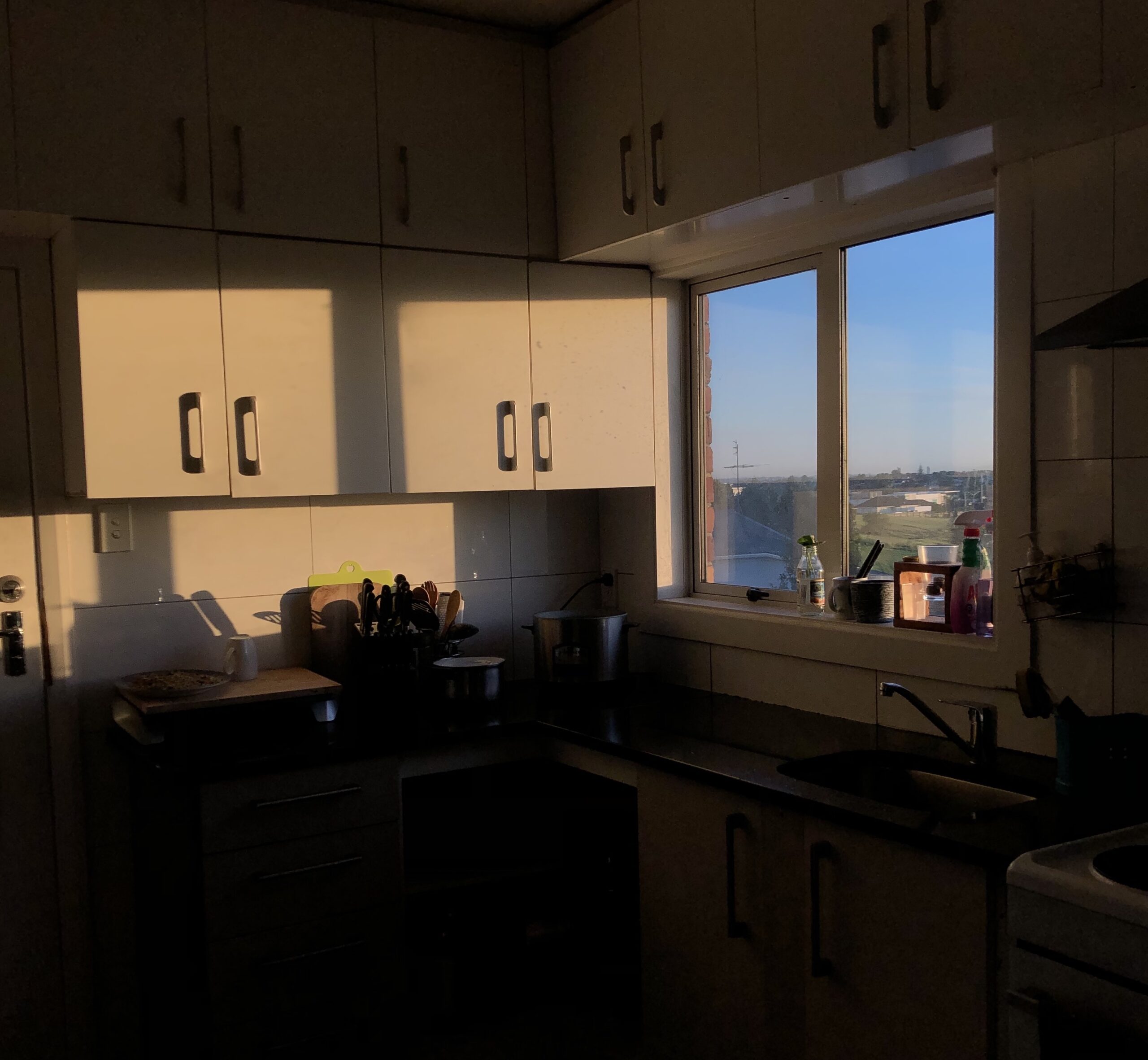
I remember standing with her in the kitchen that could never keep her out, as she showed me her arm for the first time. I must’ve looked terrified, six years old with a weak stomach. Her smile was a crack through dried clay as she tried to reassure me. She traced her finger along the outline of the scar, mapping it out like we were looking at an atlas. “This is the North Island,” she said, grazing over the narrow strip of land where the scar began. “And here,” she took my fingers and guided them to the barely healed flesh, pressing them into where the island started to widen like the wings of a stingray. “This is home.”
The oven door had started to slam closed while she was taking out a batch of malu paan, trapping her arm inside the searing heat for a few fatal seconds. Second-degree burns. Blistered, sticky, melted skin, like hot wax dripping off a candle. Her arm was in bandages for weeks. I never realised back then that she was in pain. I never saw her in pain. Or maybe I wasn’t paying enough attention.
Maybe now, if I think back hard enough, I can imagine the way she trembled as I pressed down on the curve of Auckland splayed across her arm, wondering why it felt so rough under my fingertips. Her swollen eyes from sleepless nights, fretting over the wasted batch of malu paan as it scattered across the floor, over her good arm being out of commission, over where the money would come from if she couldn’t cook. I never saw any of it. I never realised that when she snapped back into work a week later, it wasn’t a choice. It was because she didn’t know how to survive without it.
The oven door had started to slam closed while she was taking out a batch of malu paan…
Amma owned a takeaway shop on the corner of Penny Avenue. Across the street from the primary school, the last shop on a strip of shops. A dairy, an op shop, a beauty salon and Ceylon Caterers—burnt-orange walls and a peeling sign. It was everything to her. Four walls of promise, and a kitchen she built with her own hands. Her kitchen. With steel prep tables and an industrial freezer. “Just like a real restaurant,” she would say, with a joy in her voice that I haven’t heard since.
Opening day is a fresh painting in my mind—I remember every brush stroke and colour. The entire Sri Lankan Muslim community had shown up, with people spilling out through the door and onto the street. When the tables were filled up, they sat on the curb and ate their rice out of takeaway boxes. Everyone loved her food. Aunties arrived in the morning and helped prep the ingredients. The cabinet was filled with fresh cutlets, rolls, patties and malu paans. She had a set menu for the entire day, and everyone stayed long after closing for black coffee and plain tea. I remember standing at the floor-to-ceiling shop window, staring into the filled tables and thinking it was going to be like this every day.
As the weeks rolled on, the crowds dwindled but Amma still worked like it was opening day. Most of my memories of that year were from the shop. After school, I would sit at the table out front in my blue and green uniform, doing my homework, colouring, watching people come in and out of the shop. Sometimes I would sit at the cash register and count the coins, pretending I worked there, like I was taking orders. I sat on top of the freezer with my legs swinging and watched her work. Standing over a hot stove, elbows splattered with grease. Vats of mutton, chicken and beef curry filled to the brim and bubbling over with liquid gold gravy. Scooping it onto her palm and licking it off to taste. Frizzy curls stuffed into a hair net, sweat dripping from her forehead. Her eyes were bright, she was made of fire and life. She was invincible.
Her eyes were bright, she was made of fire and life. She was invincible.
Amma became fireproof after the injury. She picked up scorching rotis from the burner and flipped them over, pressing her palm flat against a pan to check if it was hot enough. I even watched her take a tray out of the oven with her bare hands because she couldn’t find her dish towel. Unflinching, ruthless, her scarred skin was now made of steel. She was in constant battle with her kitchen; temperamental and deadly like a controlled gas leak. She refused to lose to it again.
I got caught in the crossfire once, when the metal head of her spatula accidentally grazed my arm. I flinched so violently that it startled us both. She froze, eyes widening as the roti sizzled on the stove in front of her, then she started laughing. The spatula had barely touched me, a quick flash of heat that set me squealing, and she thought my overreaction was funny. She did that sometimes—laughed when I cowered from pain, when I found something terrifying. I think she couldn’t believe how she raised someone so sensitive. How this is what became of me: the youngest child who cried at the gentlest breeze. “Be strong,” she always told me, but I never understood—how could I be as strong as her?
I watched that kitchen take her apart piece by piece, and it started with her hands. I used to spend a lot of time looking at them. They looked nothing like mine. I inherited my hands from my father—stubby nails, discoloured and wrinkled like an old man’s. Her hands were large, with slender fingers and sharp nails sometimes stained with turmeric. You had to get your hands dirty to make Sri Lankan food—like fixing a car engine or cleaning out a gutter.
When she made godamba roti, she spent hours hunched over the kitchen counter, her hands caked in clumps of flour and oil as she carefully kneaded the dough over and over again. It was the only way to make sure the roti was perfectly flakey. Repeated steady motions. She pulled the dough apart and pressed it back together, moulding it under her hands, breathing life into it. She would do this every morning. It made her wrists ache, sparked up her nerves like exposed wires, but she never missed an order. She kept going. She kept making roti, even as the pain burrowed its way into her pulse and settled there permanently.
When her carpal tunnel flared up, she started wearing an arm brace. She never talked about the pain, but I could tell it bothered her. She kept kneading her dough and making her idiyappam. She still squatted over the kitchen floor and scraped coconuts raw. Through the years, Amma’s carpal tunnel got worse. She had multiple surgeries, injections, physiotherapy sessions, until eventually she had to cut back on the orders. She never talked about her pain, but sometimes I could feel it in my own hands. A sharp, electrifying sting that shot up from my middle finger to my elbow, nerves getting plucked like guitar strings. Something that made me flinch as if I was burned.
I feel the rush of searing heat and think about Amma.
I still feel that pain sometimes—when I’m hunched over my notebook, gripping too tightly to my pen as my hands try to catch up with my thoughts. It spreads through my veins like a wildfire, rendering my entire left arm useless. It flares up sporadically, like when my fingers hit my keyboard too roughly, or my hand tenses around my computer mouse. I feel the rush of searing heat and think about Amma. About how she can’t make idiyappam anymore. How she poured her entire soul into the kitchen—how I never learned moderation from her. How I break my wrists to tell a story, and she breaks her wrists to make mine.
She only had the shop for two years before it became a money pit. We would drive past it every morning on the way to school. The orange walls were painted over, the sign taken down. It was a bakery now. “Remember the shop?” she asked me repeatedly over the years. “We had so much money back then. We were so successful.” Her voice was small and wistful, talking about the shop like it was a faraway dream. Like something that could’ve been possible had she been anyone but herself.
The burn scar on Amma’s arm is barely visible anymore.
The burn scar on Amma’s arm is barely visible anymore. We’re driving to get coffee, and her sleeve slips down her arm. I’m curled up on the front seat. She hasn’t driven me anywhere in two years. I look at her hands clutched around the steering wheel, nails no longer stained with turmeric. “Where’s your scar?” I ask her.
She makes a confused sound. “Which one?”
“The burn, the one that looks like New Zealand.”
“Oh.” She laughs a little, like I said something funny, and pulls her sleeve aside to show me. The scar has faded now, down to little speckles that spread across her arm, like the skyline of a city from a plane. It barely has a shape anymore. The further up her arm it gets, the more it fades.
Huh. I always thought it would be there forever.