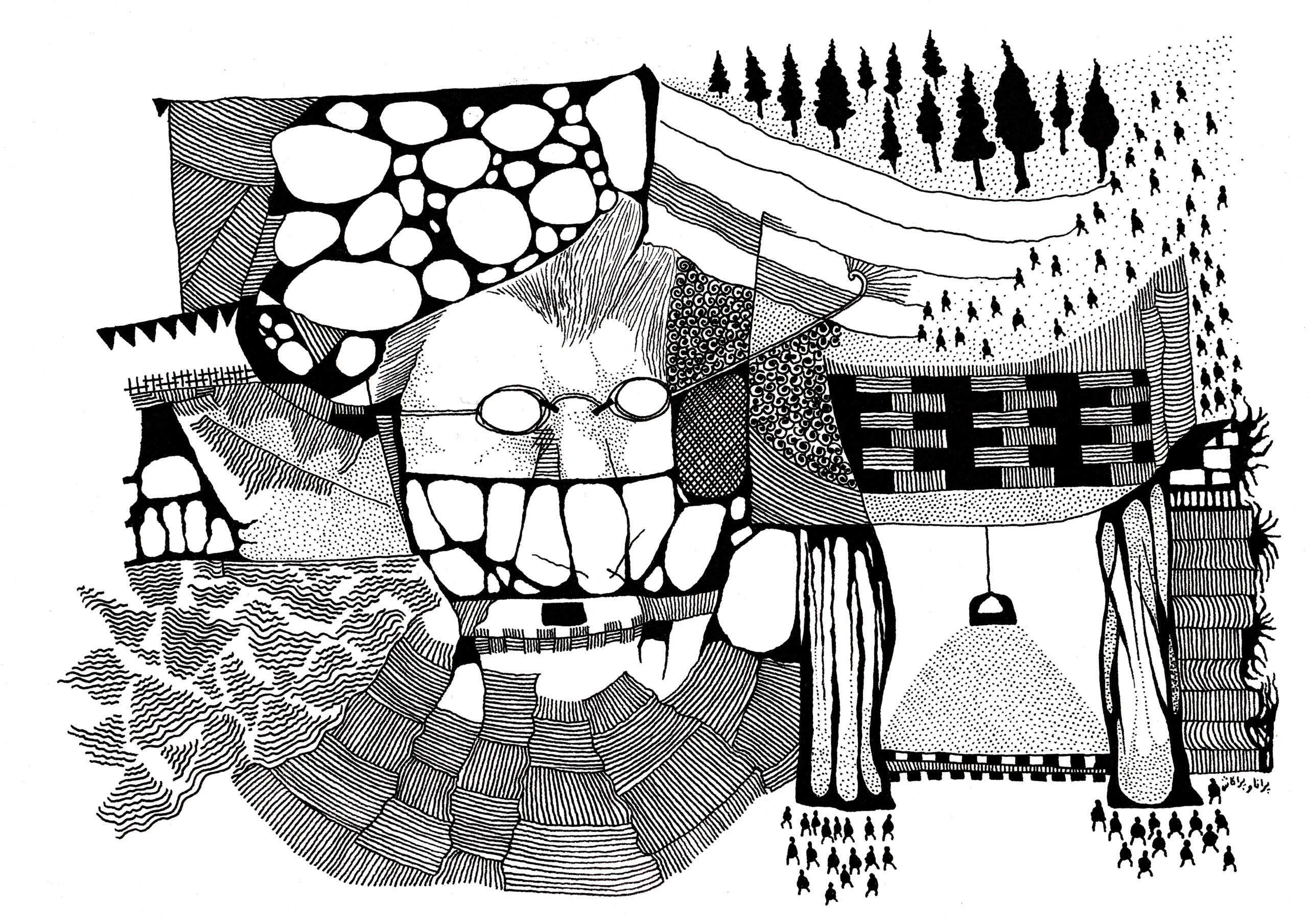
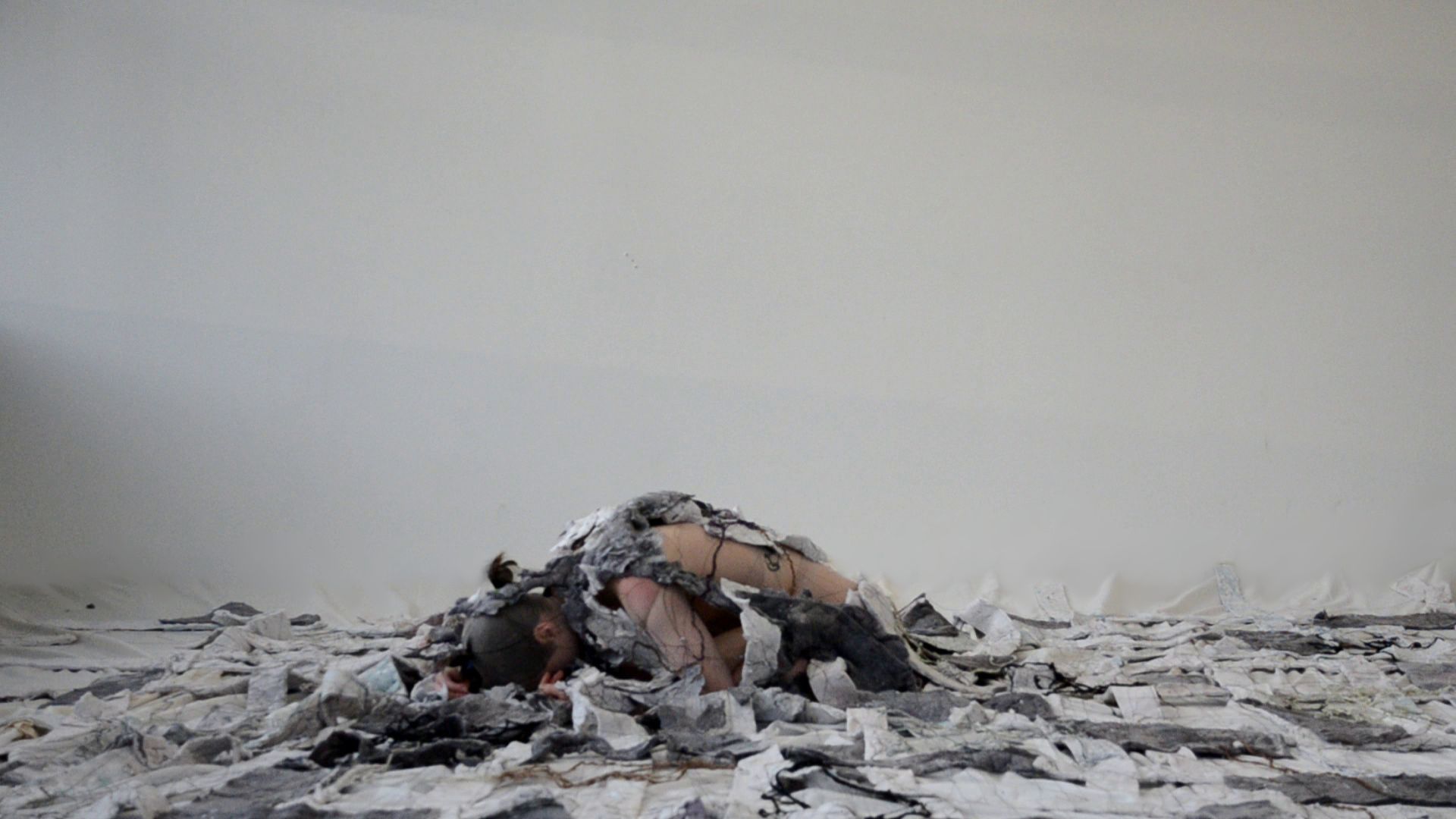
I watched a painter trace an inverted image and found myself wondering how that reflection would read if it were me, in words.
In Arabic, a father calls his child Baba, father, and a mother sings for Mama, mother. A father’s sister laughs Amto, paternal aunt; a father’s brother winks Amo, paternal uncle. A mother’s brother smiles Khalo, maternal uncle, and a mother’s sister pleads Khalto, maternal aunt. Grandparents bandage you Gedo and Teta, grandfather and grandmother. I, barely, whistled myself like the sound of a wave, always moving the same around so many shores.
When I was a child, I often kept my eyes on the ground, my body answering as though it was tumbling into the concrete and six feet under into a decomposing casket, yearning for a softer soil, a softer tongue. Wherever we would walk, my father would be a few feet ahead, long legs streaming down the sidewalk, cold air fought off by a cloud of smoke and red dry freezing hands already rolling the next cigarette, eyes closed fixed towards the sky.
Half-dead man walking, and the only footsteps I could follow. I’ve told myself it’s somewhere there, in that gulf of wonderland, that I learned how I was named.
Reconnais-tu le mal-être ?
Te reconnais-tu dans le mal-être ?
Connais-tu le mal-être ?
For the first six years of my life, nobody called me by my name. Yet, I have missed… I’m finding it hard to write in English, speak in French, think in English or laugh in French. But here I am, trying to find words to convey
what a privilege it is to choose the ability to look away from suffering.
“Baba, how many times do you open your eyes in a day?
– As many times as a drop hits a window, Baba.”
In a way, I would rather talk to the stone, the majnoone tree, the oil stain on the tablecloth, the old man putting his hands in burning oil to make us falafel, the Nile, the sea and the fish squirming in the sky.
I am somewhere in Cairo, thinking about being in Bethlehem.
A ceasefire has just been announced. And broken.
I don’t feel more alive; I feel on edge and unsurprised.
People on the streets don’t smile too much here, and they find it strange when you smile at them. When I call him to tell him, my father says it’s because everyone is tired. I can see how the exhaustion here is as loud as the constant laughter known to our people.
[ – mother with her two children
eating dry bread
– husband performing a magic trick
to a crowd
– woman fighting off policeman on
the subway
– boys fighting on the subway
– man sleeping next to his corn cart
– girls sitting on the wagon’s floor,
eyes closed ]
I am in Bethlehem, thinking about being in Cairo.
Cairo hasn’t had its first rain of the winter yet.
The trees are covered in dust, and the people are longing for a drop of water to come.
It’s been raining for the past two days here, and we’re all walking in the street, heads uncovered, coats soaked, rain drenched, markets open, and, I think, of all the things that happen to this people, it certainly won’t be rain that stops them, not here and not in Gaza.
[ – boy with garbage bags to cover his
wet feet
– news
– man doused in water selling
basboussa
– little girl running beside cars, hair
soaking wet
– mechanic looking up at leaking car
– man refusing change
– boy waiting for father
– checkpoint closed
– city closed off
– checkpoint closed
– checkpoint bigger
– checkpoint closer to our town ]
I love Cairo and Bethlehem for very different reasons.
“Baba, why is everyone looking up at that man?
– He’s just learning how to dive, Baba.”
In Cairo, I have always loved our tall buildings. The millions of lives that happen simultaneously, the ones that don’t ever stop, that have eyes so worn-out but alive. I spend a lot of my mornings on my balcony, watching the 14 buildings across from me, looking for a movement, a flowing carpet next to a father’s drying clothes, a child’s pigtails, a mother on the phone, a couple sharing a cigarette, a grandmother feeding the pigeons or a grandfather drinking his coffee with his daughter.
I don’t dream of sand anymore, or the sea.
I don’t yearn for the adan, or for a cup of roz we laban
I eat my aunt’s molokheya quietly,
I look at the doorless elevator go up and down.
I buy a bag of mangoes that I inhale on the steps with the hallway’s cat.
I am here alone, with loneliness a friend and chaos a welcomed companion.
In Bethlehem, I have always loved our beige alleys. The millions of stones that have watched over us for thousands of years, the ones that always wake up with us, that have ears tainted with inflicted foreign violence. I spend a lot of my evenings walking through those alleys, watching the walls we look after, looking for the little girl on her scooter, the jeweller who always says goodnight, the old woman packing away her bags of daily vegetables, the young men looking for somewhere to go, the sisters laughing around the corner.
I walk alone through the alleys
The knafeh is soft in my mouth
I don’t dream of olives anymore, or the mountain
I think of my Sido and Siti, my father’s parents
I eat a falafel sandwich covered in shata
I look at the square filling with carts, screams and the smell of coffee
I buy some herbs on the way home
I am here alone, with loneliness a friend and walls an unwelcomed companion.
Time has become so elastic. I have missed the sound of my name. The suffocation of the city, the colours, the crowd, the movement, the smell, the sound and the closeness of the range. I make my way downtown and to the old city; there is always something happening, good or bad.
“Sido, where do you go when you can’t breathe?
– I go where the dewdrop falls, Sido.”
[ – fabric blowing on balcony
– father with his sleeping boy in his
arms
– flailing balcony wall on rooftop
– chairs made of milk cartons
– street dog walking me home at
4 am
– bubbles
– curly hair in a theatre room ]
I look around me and everyone looks like me, in a theatre, in the Al Horeya (freedom) bar, on the subway, on the street café watching old men play tawla every night, on the sidewalk. Amongst them, I
sit with a watching him
sit with a watching her
sit with an watching him
sit with a watching her
Paint, Breathe, Write, Cry, Work, Exhaust,
Scream, Listen, Oscillate, Thread, Carry, Write,
Sweep, Gather, Shout, Bend, Kneel, Stand,
Listen, Tremble, Claim, Dig, Illuminate, Hover,
Haul, Murmur, Gather, Fold, Trace, Stretch,
Ignite, Stumble, Endure. Stand, Bear, Listen,
Confront, Strike, Shatter, Forge, Defy, Endure,
Hold, Persist, Breathe, Try, Rise,
“Khalo, will you teach me how to swim?
– I’ll teach you how to fall into the sea, Khalo.”
There is a face with no lines, like the wrinkles on the visage of the city.
Somebody told me stillness is opposite to belonging and that to paint the Nile you have to see her lines.
[ – girl screaming on the Nile bridge
– wedding on an oscillating boat
sailed by a child
– five men sitting on a tire mountain
on a small pickup flying on the
highway
– former convict making palm-sized
wooden chairs in the market
– woman crying on the subway
– car accident ]
I get out of the car and look at the damage, so does the other driver. Nobody is angry, this is too common. We navigate a dance between cars, as if choosing a life of faith, just in case. A man hands me a rose I have to pay for and
“Amo, why do you think the ladybugs like it in here?
– They don’t want to get sucked into the wave of the wind, Amo.”
[ – the microbus is full of tired faces
– a motorcycle zooms by, carrying 2
medium-sized bodies and 3 small
ones
– I run into a familiar face, but we
scurry off in opposite directions of
the streaming car lights
– on the subway a newborn is
staring at me at midnight
– a woman buys a new hijab from
the boy who sold me chocolate
yesterday
– a young boy comes and sits next
to me and draws on my hand
– two young men fight on a highway
overpass
– a bright dress shop
– a brand-new espresso machine
operating in an old Volkswagen
beetle on the side of the road ]
“Mama, how does it feel?
– Damp, and a little too crowded, Mama.”
In both these cities there is exhaustion.
It’s the kind of exhaustion that comes with carrying a world you never asked to take care of.
The kind where your fruits are stolen, where your olives are burned, where your sky is polluted by fire and storm and where the drought is forced upon you. Where your culture is hijacked, where your movement is controlled, where your beliefs are demonized, where your life is taken from you like a feather.
This land is as tough as it is soft. It has been forced to mutate into operation. You have forced us to mutate to the way the western world chooses to function so that we can survive you. We are constantly reactive, and no matter how chaotic, no matter how poorly you might view it, our mutations, our multitudes, our life will always find a way to be free and alive.
There are many things I don’t know, but I know I wouldn’t want to be anywhere but somewhere in Cairo and Bethlehem.